高血壓 高尿酸 慢性腎病 胰島素 https://2019medicinenote.blogspot.com/2019/12/blog-post_57.html . 糖尿病相關筆記~目錄 https://2019medicinenote.blogspot.com/2020/01/blog-post_4.html

2025年11月27日 星期四

類固醇等效劑量-demamethasone 4mg 相當於 methylprednisolone 21mg 或 prednisolone 27mg

2025-11-28 9:56AM
高海拔疾病研究最多的類固醇是 demamethasone. 
demamethasone 4mg 相當於 methylprednisolone 21mg 或 prednisolone 27mg

2025年11月24日 星期一

野外與登山醫學-個案討論 ASTHMA OR HAPE

2025-12-05 剛剛把這篇筆記丟到ChatGpt請它協助糾錯. 得到這篇筆記

使用chatgpt校正文章內容 2025-11-24 最近有個朋友遇到的問題. 先把他的敘述拷貝一下

Ama-dablam 基地營在4600米,基地營聯合急診處的伊朗籍醫生幫我檢測,我血氧始終維持在95附近,但心跳高達95-100,他認為我心跳過快(我過去在這高度血氧大約90多,心跳在80附近),要我給他看我日常吃的藥物。
他說我吃的氣喘藥中的三種類固醇會造成心跳加速,要我停用,但他沒有氣喘替代藥物。
他同時認為我肺部因感冒久咳發炎,無法承受6000米以上壓力,且短期無法康復,要求我停止攀登。
停藥兩天後氣喘發作,所以恢復用藥。
我嘗試做掙扎,於是詢問伊朗登山會秘書長Saberi,秘書長顯然與這位醫生不熟,但他回覆我:「我知道這個人,他是好人。」
我決定放棄攀登。
營地中非常資深的Mountain Guide 觀察我,他認為我最少可以上攀到C2,之後再視身體狀況而定。
陪同呂果果登頂安娜普魯娜的Mountain Guide 邀我們與他的客人一起上攀至5000米做高度適應。
他認為我狀況很好,但不時會咳嗽,所以他無法對我做出建議。
兩天後,與我同登山公司的波蘭夫婦從C1高度適應回來。先生為開刀房醫生,他提議幫我再做詳細檢查。
他認為我肺部沒有問題,但氣管因久咳黏膜受損,只要維持溫暖潮濕就可以。
我聽我想聽的,我決定繼續攀登。
我逐漸減少類固醇用藥,並在攻頂前停止服用類固醇,自以為可以降低心跳。
第一次登頂時,發生全身無力恍神的狀況,最後撤回C2。
回到C2後依然全身無力恍神、心跳用力且快速,並伴隨輕微頭痛。十數小時後,我用盡全身力氣找出藥袋,並服用日常服用藥物(包含所有類固醇)最低量,半小時後恢復精神與基本體能
*
當晚我增加類固醇劑量,發動第二次攻頂。
*
*
我對自己的生理反應感到陌生和恐懼,我完全不認識自己的身體了。
前天詢問在醫院當主任的朋友,他單憑問診無法判斷原因。
我剛剛詢問AI,以下截圖是AI的答覆。
不知道是否正確。
總之我被AI罵了--玩命。


2025-11-24 17:52
看完他的截圖. 只能說CHATGPT 很厲害. 我整理一下我的考量
1. HAPE的血氧飽和度通常會低於預期值10% (預期值是指大部分正常人的數值. 例如大多數人在聖母峰基地營的血氧飽和度約83%) 

2.類固醇用於高海拔. 研究最多的是dexamethasone. 但也有少數研究使用prednisolone預防HAPE.但使用的劑量是以10mg和20mg做比較. 0.5mg的prednisolone劑量真的太小了. (dexamethasone 4mg相當於27mg的prednisolone)

** 類固醇等效劑量可點這裡

氣喘急性發作初期. 還沒感覺喘之前 . 有些患者最初的表現只有咳嗽. 但感冒或其他肺部感染也會增加氣喘發作機率. 臨床上. 我會先當成嚴重的來治療. (先將咳嗽推定為早期氣喘). 這時候會先給予吸入性類固醇加上長效氣管擴張劑(LABA+ICS). 但在高海拔. 咳嗽的症狀要優先考慮是否為高海拔肺水腫HAPE. 若是單純高海拔肺水腫, 症狀(咳嗽或喘)在吸氧之後應該會迅速改善. 但吸氧之後症狀沒馬上改善(症狀持續). 也不能直接排除肺水腫. 需要鑑別診斷的原因. 主要是決定怎麼治療/處置
3. 若判斷為HAPE, 最重要的處置是考慮下撤(降低海拔高度1000公尺). 下撤途中可使用藥物 NIFEDIPINE 作為輔助治療. 但藥物不能取代下撤.
4. 若不是單純HAPE. 偏向氣喘發作. 需考慮藥物治療. 使用擴張劑/類固醇(LABA+ICS)
5. 若懷疑是肺炎. 除了上面藥物. 需使用抗生素.
若診斷不明. 無法在現場得到明確診斷. 建議先開始藥物治療. 隨時準備下撤. 畢竟命只有一條.

6. HAPE早期症狀包含發燒(通常不高, 約 38.5度C). 但肺炎也可能發燒(通常會發燒. 有時燒很高). 發燒與否不能直接排除(或確定) HAPE 或肺炎. 發燒38.5度C以下不能排除肺炎. 但高燒的患者是肺炎的機率會上升. 

7. 聽診不能直接排除肺炎. 喘鳴聲在肺水腫患者同樣會出現(黏膜水腫造成細支氣管通道狹窄). 在低海拔(台灣多數城市)的肺水腫患者. 之前的臨床經驗是給予霧化擴張劑吸入治療. 病患會越吸越不舒服. 但這種反應也不是絕對. 在急診室還可以照X光做參考. 在山上只能根據症狀(端坐呼吸orthopnea).臨床進展.身體檢查(聽診.血氧機.發紺)來猜. 

8.肺水腫(包含高海拔以外的肺水腫)可能會乾咳. 之後咳泡沫痰. 再嚴重會咳出血色泡沫痰. 端坐呼吸(躺下更喘). 下肢水腫在HAPE比較少. HAPE患者體內常常是處於脫水狀態. 

肺炎(各種細菌感染)可能會咳黃痰.鐵鏽色痰.(痰的顏色及可能相應的疾病可參考這裡)

感冒(各種病毒感染)通常是白色痰. 也可能咳黃痰. 不能以黃痰就推斷為肺炎. 

9. 臨床進展舉例. HAPE通常發生於抵達高海拔2-4天之間.在相同海拔. 前幾天沒症狀. 超過五天才出現的症狀. 高海拔疾病的機率較低. 


2025年11月18日 星期二

罹患流感痊癒之後仍建議打流感疫苗

2025-11-19
罹患流感痊癒之後仍建議施打流感疫苗
1. 流感型別可能轉換. 痊癒之後仍可能感染其他型別的流感(其他A型.或B型)
2. 疫苗包含AB型抗原(還有其他佐劑). 

以國光安定伏AdimFlu-S四價疫苗為例
安定伏" 裂解型流感疫苗 AdimFlu-S主成分:
每0.5mL疫苗含有下列流感病毒株中血球凝集抗原(hemagglutinin; HA),含量為: 
A/Victoria/4897/2022 (H1N1)pdm09-like virus A/Victoria/4897/2022 (IVR-238)…………….....……...……....……....……. 15μg/0.5mL
A/Croatia/10136RV/2023 (H3N2)-like virus A/Croatia/10136RV/2023 (NYMC X-425A) .……..……....……....……. 15μg/0.5mL 
B/Austria/1359417/2021-like virus B/Austria/1359417/2021 (BVR-26)……………….......……....……....……. 15μg/0.5mL 
pH 6.8~8.0,滲透壓比(對生理食鹽水)約1。 
本疫苗係將流感病毒株接種於發育中的雞蛋尿膜腔內,培養後,抽出含病毒之尿膜腔 液,經蔗糖密度梯度離心法將病毒粒子分離及濃縮後,以乙醚將病毒粒子分解,取其 HA片段。以福馬林不活化後,用磷酸緩衝溶液稀釋調製,使溶液中含有規定量之病毒 株HA。 
疫苗中的病毒株是根據WHO(北半球)建議而決定,供2025/2026年流感季節使用。 
本疫苗含有微量甲醛(Formaldehyde)和聚山梨醇酯80(Polysorbate 80)等在製 程中會使用到的成分。其他賦形劑請見1.2。 1.2 
賦形劑 磷酸緩衝溶液含有以下賦形劑成分: 氯化鈉 (Sodium chloride) 、磷酸氫二鈉(Disodium hydrogen phosphate)、磷酸 二氫鉀(Potassium dihydrogen phosphate)以及注射用水。


[yahoo新聞] 得了流感還能打疫苗嗎? 疾管署長羅一鈞:有這「3條件」都可打

衛福部疾病管制署署長羅一鈞表示,即使剛得過或得完流感,只要沒發燒、流感症狀已緩解,經醫師評估合適,都可以打。


羅一鈞於臉書發文表示,目前正在流行A型流感,流感病毒因為有A流B流,疫苗也是內含三種型別,所以一般都不特別規定「得過流感之後XX天不能打流感疫苗」,即使剛得過或得完流感,只要沒發燒、流感症狀已緩解,經醫師評估合適,都可以打。

此外,目前國內上升的流感同時也伴隨著「流行型別轉換」,從附圖可看到最右邊是最近幾週,灰色區域代表的A(H3N2)流感已要超車藍色區域代表的A(H1N1),符合世衛年初觀察到H3N2已變也因此更換疫苗株(去年H3N2疫苗株是泰國株、今年換成克羅埃西亞株),因此最近得過A流的人,還是可能因為流行型別轉換後又再得到不同的A流,建議還是要打10月最新的流感疫苗、取得最新保護。

衛福部表示,依據監測資料,第39週(9月21日至27日)類流感門急診就診達12萬9831人次,較前一週增加一成,疫情已進入流行期,主要病毒型別以A型H3N2為多,其次為A型H1N1及B型。針對花蓮馬太鞍溪堰塞湖災區,疾管署也將收容所民眾、光復鄉居民及救災人員納入公費流感與新冠疫苗優先接種對象,並提供公費抗病毒藥物,保障災後健康。

2025年11月17日 星期一

GOLD 2026 更新摘要 COPD 治療可參考 eosinophil 數值

 2025-11-18 11:03AM

https://www.facebook.com/photo?fbid=1408711724160580&set=pcb.1408712080827211

一種氣管擴張劑 LAMA  or LABA

兩種氣管擴張劑 LAMA  + LABA

三種 氣管擴張劑 LAMA  +  LABA + ICS

初始若 EOS > 300 使用兩種或三種氣管擴張劑 LAMA + LABA

追蹤後. 若症狀惡化且 EOS > 100 可使用三種氣管擴張劑

若使用三種氣管擴張劑仍惡化或頻繁發作. 考慮使用生物製劑

生物製劑主要是阻斷 IL-5, 減少 EOS

mepolizumab 或 benralizumab 

急性惡化期. 建議使用短期口服類固醇(<5天)

抗生素不建議常規使用(痰液增加或變稠考慮使用口服抗生素)


2025年11月4日 星期二

111年衛福部新聞-補充維生素可能會增加特定疾病風險或提高死亡率

2025-11-05 
下面的各種研究有點反直覺. 民眾服用維生素是希望減少某些疾病. 結果可能與我們想像的截然不同. 多年之前曾看過文獻. 長期服用維生素會增加死亡率


研究團隊與國衛院高齡醫學暨健康福祉研究中心的許志成執行長合作,利用台灣健保資料庫進行分析,發現未罹患失智症的年長者若每年服用活性維生素D3(calcitriol)超過146天,其日後發生失智症風險是未服用者的1.8倍。若失智症患者每年服用維生素D3超過146天,其死亡風險是未服用者的2.17倍。

但在uptodate裡面的相關資料跟上面的矛盾.
uptodate 認知能力下降和失智症的風險因素
維生素D缺乏症
有證據表明,維生素D缺乏與老年人的認知障礙和阿茲海默症有關[ 2,298 ]。但這種影響似乎較小,其臨床意義尚不清楚。

一項基於人群的橫斷面研究發現,維生素D缺乏的老年女性認知評分低於維生素D充足的女性[ 299 ];而另一項研究則發現,維生素D攝取量達到建議水準的女性認知評分高於攝取不足的女性[ 300 ]。其他橫斷面研究和病例對照研究發現,維生素D水平低的患者白質高訊號和梗塞體積較大,且有全因失智症[ 301 ]或阿茲海默症[ 302 ]的風險較高(2.0倍)。

不過補充維生素D也有益處. 例如會減少某些癌症

前瞻性隊列研究的結果並不一致。一項針對1604名老年男性進行平均4.6年追蹤的前瞻性研究發現,維生素D水平與同時發生的或新發的癡呆症之間均無顯著相關性[ 303 ]。相較之下,一項針對858名65歲以上成年人進行的隊列研究發現,在為期六年的觀察期內,低維生素D水平與認知能力下降相關[ 304 ]。另一項針對1658名老年人進行平均5.6年追蹤的研究表明,與維生素D充足狀態相比,嚴重維生素D缺乏(<25 nmol/L)與全因失智症和阿茲海默症的相對風險(RR)升高約兩倍相關[ 305 ]。

Vitamin D deficiency — There is some evidence that vitamin D deficiency is associated with cognitive impairment and AD in older adults [2,298]. The effect appears to be small and of uncertain clinical significance.

A population-based cross-sectional study of older women found that those with vitamin D deficiency had lower cognitive scores compared with those without deficiency [299], while another found that women with vitamin D intake at the recommended level had higher cognitive scores compared with those with inadequate intake [300]. Other cross-sectional and case-control studies have found that patients with low vitamin D levels have higher volumes of white matter hyperintensities and infarctions as well as higher odds (2.0) of all-cause dementia [301] or AD specifically [302].

Prospective cohort series have been less consistent. One prospective study that followed 1604 older men for a mean 4.6 years found no significant relationship between vitamin D status and either concurrent or incident dementia [303]. By contrast, low levels of vitamin D were associated with cognitive decline over a six-year observation period in a cohort of 858 adults over 65 years [304]. In another study involving 1658 older adults followed for a mean of 5.6 years, severe vitamin D deficiency (<25 nmol/L) was associated with an approximately twofold higher RR of both all-cause dementia and Alzheimer dementia compared with a vitamin D replete state [305].


「美國醫學會期刊網」(JAMA Network)。
2024年6月,美國的國家癌症研究所(NCI)8 年(1993-2001)的追蹤調查,計畫包含了39萬124名健康成年人,團隊追蹤這些受試者日常服用綜合維生素的使用情形,並分析這些人的三項主要健康研究數據。

研究結果. 
每日服用多種維生素不能降低死亡的風險
每日服用多種維生素的受試者,死亡風險反而增加了4%。


Abstract
Importance  One in 3 US adults uses multivitamins (MV), with a primary motivation being disease prevention. In 2022, the US Preventive Services Task Force reviewed data on MV supplementation and mortality from randomized clinical trials and found insufficient evidence for determining benefits or harms owing, in part, to limited follow-up time and external validity.

Objective  To estimate the association of MV use with mortality risk, accounting for confounding by healthy lifestyle and reverse causation whereby individuals in poor health initiate MV use.

Design, Setting, and Participants  
This cohort study used data from 3 prospective cohort studies in the US, each with baseline MV use (assessed from 1993 to 2001), and follow-up MV use (assessed from 1998 to 2004), extended duration of follow-up up to 27 years, and extensive characterization of potential confounders. Participants were adults, without a history of cancer or other chronic diseases, who participated in National Institutes of Health–AARP Diet and Health Study (327 732 participants); Prostate, Lung, Colorectal, and Ovarian Cancer Screening Trial (42 732 participants); or Agricultural Health Study (19 660 participants). Data were analyzed from June 2022 to April 2024.

Exposure  Self-reported MV use.

Main Outcomes and Measures  
The main outcome was mortality. Cox proportional hazard models were used to estimate hazard ratios (HRs) and 95% CIs.
Results  
Among 390 124 participants (median [IQR] age, 61.5 [56.7-66.0] years; 216 202 [55.4%] male), 164 762 deaths occurred during follow-up; 159 692 participants (40.9%) were never smokers, and 157 319 participants (40.3%) were college educated. Among daily MV users, 49.3% and 42.0% were female and college educated, compared with 39.3% and 37.9% among nonusers, respectively. In contrast, 11.0% of daily users, compared with 13.0% of nonusers, were current smokers. MV use was not associated with lower all-cause mortality risk in the first (multivariable-adjusted HR, 1.04; 95% CI, 1.02-1.07) or second (multivariable-adjusted HR, 1.04; 95% CI, 0.99-1.08) halves of follow-up. HRs were similar for major causes of death and time-varying analyses.
Conclusions and Relevance  In this cohort study of US adults, MV use was not associated with a mortality benefit. Still, many US adults report using MV to maintain or improve health.


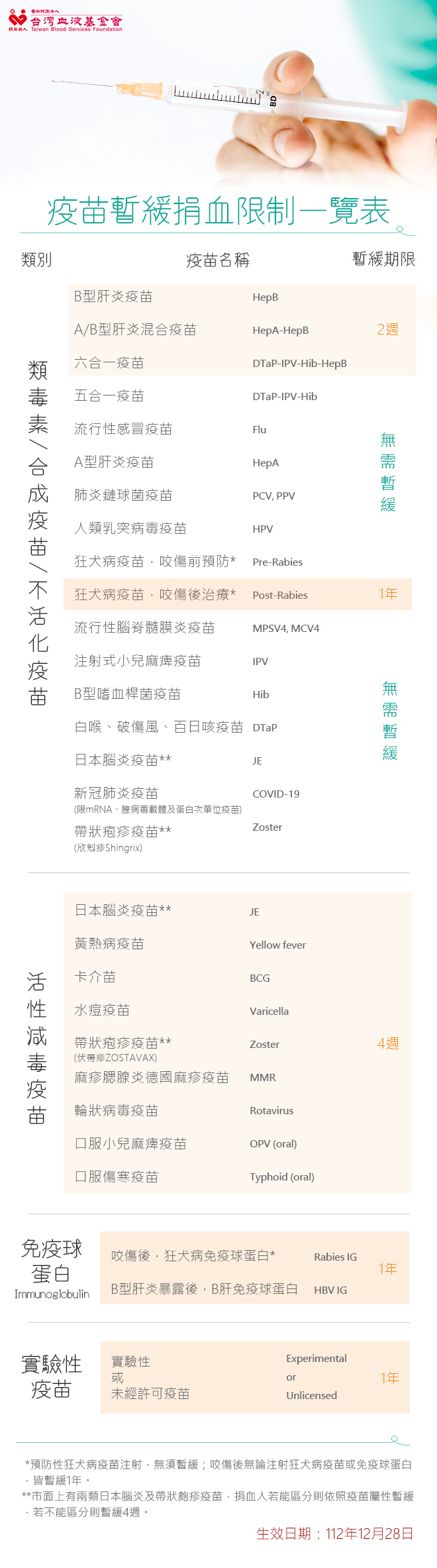
施打流感疫苗及新冠疫苗不影響捐血

2025-11-05
台灣血液基金會-疫苗暫緩捐血限制一覽表

施打活性減毒疫苗之後. 受血者可能發生感染. 若受血者免疫系統有問題. 無法應付毒性減弱的病源. 可能發生嚴重症狀. 

下面這段來自 臺大醫院-小兒疫苗 
疫苗根據是否仍然保留原來病原的活性,可分為活性減毒疫苗 (live attenuated vaccine) 與非活性疫苗 (killed vaccine) 兩大類。
目前已有的活性減毒疫苗包括卡介苗、口服小兒麻痺疫苗、麻疹疫苗、德國麻疹疫苗、腮腺炎疫苗、水痘疫苗等。此類疫苗經過減毒的製造過程,但仍保留病原體活性,打入人體以後能夠自行增殖而引起免疫反應,但通常不會致病。因此施打此類疫苗就好像是得到了輕微的自然感染,可提供較好的抗原反應,引起的免疫效果也比較持久,通常只須施打一劑即足以產生足夠的抗體。這類疫苗最主要的缺點在於可能會引起類似自然感染的病症,安全性顧慮較大。此外,活性疫苗比較容易被外來抗體中和而影響到它們的效力。


2025年11月1日 星期六

tramadol 過量-中毒的心電圖異常

2025-11-02

之前沒遇到過 TRAMADOL OVERDOSE 個案. 剛好看到FB上面的討論. 順便查詢做筆記.

第一篇
心跳過快 30.6%, 
QRS 120 milliseconds or more in 7.5%, 
corrected QT interval more than 440 milliseconds in 24.6%
height of R wave more than 1 mm in lead aVR in 22.1%, 
R/S ratio more than 0 in lead aVR in 23.5%,\
terminal 40-millisecond frontal plane QRS axis greater than 120° in 31.7%, 
and complete or incomplete right bundle-branch block in 4.6% of the patients were detected. 

There were no statistically significant differences between the patients who had not convulsed and those who had convulsed after admission regarding age, sex, vital signs, and ECG findings at presentation (all P values were >.05).
 Electrocardiographic manifestations of tramadol toxicity with special reference to their ability for prediction of seizures


Abstract

Aim
The aims of this study are to determine the electrocardiographic (ECG) manifestations of the symptomatic patients with isolated tramadol toxicity and to predict seizures based on ECG parameters.

Methods
Medical charts of a total of 479 patients with isolated tramadol toxicity were retrospectively evaluated. Their clinical manifestations were recorded, and their ECG parameters including rate, PR interval, QRS duration, corrected QT interval, terminal 40-millisecond frontal plane QRS axis, and the height of R wave and R/S ratio in the lead aVR were measured. The data were analyzed using Kolmogorov-Smirnov test, Mann-Whitney U test, Pearson χ2, Pearson correlation coefficient (r), and the Student t test.

Results
Electrocardiographic heart rate more than 100 beats per minute in 30.6%, QRS 120 milliseconds or more in 7.5%, corrected QT interval more than 440 milliseconds in 24.6%, height of R wave more than 1 mm in lead aVR in 22.1%, R/S ratio more than 0 in lead aVR in 23.5%, terminal 40-millisecond frontal plane QRS axis greater than 120° in 31.7%, and complete or incomplete right bundle-branch block in 4.6% of the patients were detected. There were no statistically significant differences between the patients who had not convulsed and those who had convulsed after admission regarding age, sex, vital signs, and ECG findings at presentation (all P values were >.05).

Conclusions
Tramadol toxicity shows ECG changes consistent with sodium channel blockade and potassium channel blockage effects. The risk of development of seizures cannot be predicted based on the changes of ECG parameters at presentation.


Introduction
Tramadol is a widely used, synthetic opioid analgesic [1], [2], [3]. It has a weak μ-receptor agonist activity that blocks the pain pathways as well as the inhibition of the reuptake of the biogenic amines especially serotonin and norepinephrine in central nervous system. The latter mechanism results in an increment in the pain threshold [4]. Tramadol toxicity can cause nausea and vomiting, hypertension, tachycardia, central nervous system depression, respiratory depression, agitation, and seizures [4], [5], [6]. Electrocardiographic (ECG) changes in opioid overdose are well described with propoxyphene [7], [8], [9], [10] and heroin [11], [12], [13], [14] including QRS prolongation, nonspecific ST segment and T-wave changes, first-degree atrioventricular block, atrial fibrillation, prolonged corrected QT (QTc) intervals, and ventricular dysrhythmias. Furthermore, a specific ECG pattern, the Brugada pattern, has previously been reported with isolated tramadol overdose [15]. However, except for the previously mentioned case of Brugada pattern in tramadol toxicity, the ECG findings of this toxicity have not yet been reported. This retrospective study aimed to determine the ECG manifestations of the symptomatic patients with isolated tramadol toxicity and the probability of prediction of seizures by the application of these manifestations.

CXR heart failure with bilateral pleural effusion

the same patient  2016-2026