2023-08-10 18:30
修改一下原文的時間, 不然過幾年之後就忘了是何時的更新
洪惠風醫師臉書
2023/07/20 美國心臟學會CCD(慢性冠心症 chronic coronary disease)新的指引,最重要的3點
1. 慢性冠心症心血管介入治療(支架....這些)跟外科繞道重新定位
2. 乙型阻斷劑 重要性降階
3. 慢性冠心症患者症狀及功能穩定時,不建議規則追蹤運動心電圖、核醫、心血管電腦斷層,也不建議定期追蹤心臟射出率,還說定期追蹤心導管,是有害的
支架或繞道最該做的兩大時機(Class I)
1) 用了所有藥物,症狀仍然影響生活品質,可用支架或繞道來減少症狀(無法減少死亡率)
2) 左主幹或多條血管阻塞 合併 左心室射出率小於35%時,繞道手術(非支架)可減少死亡率
強調醫病共享決策
2023年8月10日 星期四

DKA sodium bicarbonate NaHCO3 201601190909
2023-08-10 18:17
基本上. 我的建議是能不給就不給. 如果你堅持要給. 請說明你的理由.
醫療決策不該只治療數據. 給予碳酸氫鈉將目前 pH 值暫時校正回來.
可能會誤判 DKA 已經控制
事實上. 血液氣體分析的 pH 值, 是決定是否繼續施打靜脈胰島素的重要指標
DKA 缺的是胰島素. 當然也會合併一些脫水( NKHS 非酮酸中毒之高滲透壓血症. 脫水問題會比DKA 更嚴重)
基本上. 我的建議是能不給就不給. 如果你堅持要給. 請說明你的理由.
醫療決策不該只治療數據. 給予碳酸氫鈉將目前 pH 值暫時校正回來.
可能會誤判 DKA 已經控制
事實上. 血液氣體分析的 pH 值, 是決定是否繼續施打靜脈胰島素的重要指標
DKA 缺的是胰島素. 當然也會合併一些脫水( NKHS 非酮酸中毒之高滲透壓血症. 脫水問題會比DKA 更嚴重)
急診醫師教科書 ROSEN (忘了當初是看第幾版了) 關於 DKA部分. page 1634
裡面說. sodium bicarbonate 不建議泡在 normal saline 內使用. 因為滲透壓太高
pH < 7.1 每公斤給 1mEq. 一支NaHCO3 約 17 mEq. 成人一次可以補 3-4 支
不建議例行補充. 很多醫師甚至 pH 6.7 以上都建議不要給.
治療目標. 將 pH 校正到 7.1 即可. 讓 HCO3 上升 10 mEq/L
使用方式. 將 NaHCO3 泡在 D5W 裡面. 九支泡一公升.
考慮到這些潛在危害且缺乏已證實的益處,許多作者質疑即使在嚴重酸血症的情況下碳酸氫鹽治療的效用。 13 然而,儘管缺乏證據,但通常建議根據經驗使用碳酸氫鈉治療血清pH值低於7.1。 1 mEq/kg,除非潛在的酸中毒被認為對治療有快速反應。14 然而,許多專家不會治療pH 值高於6.7 的情況,尤其是糖尿病酮症酸中毒,在糾正潛在病變的同時,通常可以很好地耐受嚴重酸血症。治療終點包括 pH 值高於 7.1 和血清碳酸氫鹽濃度高於 10 mEq/L。通過添加 150 mEq 碳酸氫鈉(三個“急救車安瓿”,通常為 50 mL,每瓶 8 個)來製備碳酸氫鹽滴注。4% 溶液)加入 1 升 5% 葡萄糖水溶液中,並在臨床情況允許的情況下緩慢輸注。出於高滲的考慮,碳酸氫鈉通常不應添加到生理鹽水中。
Many authors question the utility of bicarbonate therapy even in cases of severe acidemia, given these potential harms and the absence of demonstrated benefit.13 However, although evidence is lacking, it is commonly recommended to treat serum pH less than 7.1 empirically with sodium bicarbonate, 1 mEq/kg, unless the underlying acidosis is thought to be quickly responsive to therapy.14 Many experts will not treat pH above 6.7, however, especially in diabetic ketoacidosis, in which profound acidemia is usually well tolerated while the underlying lesion is corrected. Endpoints of therapy include pH above 7.1 and serum bicarbonate concentration above 10 mEq/L. A bicarbonate drip is prepared by adding 150 mEq sodium bicarbonate (three “crash cart ampules,” which are usually 50 mL of 8.4% solution) to 1 liter of 5% dextrose in water and infusing as slowly as the clinical situation permits. Sodium bicarbonate should generally not be added to normal saline for concern of hypertonicity.
下面資料來自 uptodate
Diabetic ketoacidosis and hyperosmolar hyperglycemic state in adults: Treatment
碳酸氫鹽和代謝性酸中毒 — 如果動脈 pH 值低於 6.90,我們建議使用碳酸氫鹽。如果血清鉀低於 5.3 mEq/L,我們會在 400 mL 無菌水中加入 100 mEq 碳酸氫鈉和 20 mEq氯化鉀,給藥時間超過 2 小時。
Bicarbonate and metabolic acidosis — We suggest administering bicarbonate if the arterial pH is less than 6.90. We give 100 mEq of sodium bicarbonate in 400 mL sterile water with 20 mEq of potassium chloride, if the serum potassium is less than 5.3 mEq/L, administered over two hours.
應每兩小時監測一次靜脈 pH 值和碳酸氫鹽濃度,並且可以重複碳酸氫鹽劑量,直到 pH 值升至 7.00 以上(參見下面的“監測”)。當碳酸氫鹽 (HCO3) 濃度增加時,血清 K 值可能會下降,可能需要更積極的 KCl 補充。
The venous pH and bicarbonate concentration should be monitored every two hours, and bicarbonate doses can be repeated until the pH rises above 7.00 (see 'Monitoring' below). When the bicarbonate (HCO3) concentration increases, the serum K may fall and more aggressive KCl replacement may be required.
DKA 中碳酸氫鹽治療的適應症存在爭議[ 34 ],並且缺乏益處的證據[ 35-37 ]。在一項對 21 名入院動脈 pH 值在 6.90 至 7.14(平均 7.01)之間的 DKA 患者進行的隨機試驗中,碳酸氫鹽治療並未改變發病率或死亡率[ 35 ]。然而,該研究規模較小,僅限於動脈pH值6.90及以上的患者,碳酸氫鹽組和安慰劑組之間動脈pH值和血清碳酸氫鹽的上升率沒有差異。尚未進行有關在 pH 值低於 6.90 的 DKA 中使用碳酸氫鹽的前瞻性隨機試驗。
The indications for bicarbonate therapy in DKA are controversial [34], and evidence of benefit is lacking [35-37]. In a randomized trial of 21 DKA patients with an admission arterial pH between 6.90 and 7.14 (mean 7.01), bicarbonate therapy did not change morbidity or mortality [35]. However, the study was small, limited to patients with an arterial pH 6.90 and above, and there was no difference in the rate of rise in the arterial pH and serum bicarbonate between the bicarbonate and placebo groups. No prospective randomized trials have been performed concerning the use of bicarbonate in DKA with pH values less than 6.90.
碳酸氫鹽的給藥也存在爭議,因為除了缺乏證據證明其益處外,還存在一些潛在的有害影響: ●如果碳酸氫鹽輸注成功地增加了血液碳酸氫鹽濃度,則可以
Bicarbonate administration is also controversial because in addition to lack of evidence for benefit, there are several potential harmful effects:
減少過度換氣驅動,從而升高血液pCO2。血液 CO2 張力的增加比動脈 HCO3 的增加更快地反映在血腦屏障上。這可能會導致大腦 pH 值的反常下降。儘管神經系統惡化已歸因於這種機制,但它仍然是一個非常有爭議的效應,而且即使發生,也很少見[ 38 ]。
●If bicarbonate infusion successfully increases the blood bicarbonate concentration, this can reduce the hyperventilatory drive, which will raise the blood pCO2. Increased blood CO2 tension is more quickly reflected across the blood brain barrier than the increased arterial HCO3. This may cause a paradoxical fall in cerebral pH. Although neurologic deterioration has been attributed to this mechanism, it remains a very controversial effect and, if it occurs, is rare [38].
●服用鹼可能會減慢酮症的恢復速度[ 39,40]。在一項針對七名患者的研究中,三名接受碳酸氫鹽治療的患者血清酮酸陰離子水平升高,酮症消退延遲六小時[39 ]。動物研究表明,碳酸氫鹽輸注可以加速生酮。這被認為與酸血症對有機性酸中毒有“制動作用”有關。任何增加全身 pH 值的操作都會減弱這種制動作用 [ 35 ]。
●The administration of alkali may slow the rate of recovery of the ketosis [39,40]. In a study of seven patients, the three patients treated with bicarbonate had a rise in serum ketoacid anion levels and a six-hour delay in resolution of ketosis [39]. Animal studies indicate that bicarbonate infusion can accelerate ketogenesis. This is thought to be related to the fact that acidemia has a “braking effect” on organic acidosis. This brake is lessened by any maneuver that increases systemic pH [35].
●給予鹼可導致治療後代謝性鹼中毒,因為酮酸陰離子與胰島素的代謝會導致碳酸氫根的產生,並自發糾正大部分代謝性酸中毒。(參見“成人糖尿病酮症酸中毒和高滲性高血糖狀態:流行病學和發病機制”,關於‘陰離子間隙代謝性酸中毒’一節)
●Alkali administration can lead to a posttreatment metabolic alkalosis, since metabolism of ketoacid anions with insulin results in the generation of bicarbonate and spontaneous correction of most of the metabolic acidosis. (See "Diabetic ketoacidosis and hyperosmolar hyperglycemic state in adults: Epidemiology and pathogenesis", section on 'Anion gap metabolic acidosis'.)

There are, however, selected patients who may benefit from cautious alkali therapy [38]. They include:
●Patients with an arterial pH ≤6.9 in whom decreased cardiac contractility and vasodilatation can further impair tissue perfusion [41,42]. At an arterial pH above 7.00, most experts agree that bicarbonate therapy is not necessary, since therapy with insulin and volume expansion largely reverse the metabolic acidosis [43].
●Patients with potentially life-threatening hyperkalemia, since bicarbonate administration in acidemic patients may drive potassium into cells, thereby lowering the serum potassium concentration [44]. (See"Treatment and prevention of hyperkalemia in adults".)
一篇 2011 年回顧文章說. 沒有證據顯示在 DKA 給予 bicarbonate 有好處. 尤其是兒科病人. 在 pH 6.9 以下也缺乏足夠證據給予建議.
處理目標, 減少高氯酸中毒, 減少 CSF 酸化, 減少腦水腫.
http://www.ncbi.nlm.nih.gov/pmc/articles/PMC3224469/
Conclusions
The evidence to date does not support the use of bicarbonate administration for the emergent treatment of DKA, especially in the pediatric population, in view of possible clinical and physiological harm and the lack of clinical or sustained physiological benefits. There also is insufficient evidence to justify the recommendation of bicarbonate administration in more extreme acidemia of pH < 6.90. Future research should focus on the use of more balanced and physiological resuscitation fluids with buffering capacity, in the modern context of DKA management, with the goal of reducing the component of hyperchloremic acidosis in DKA while minimizing the risk of CSF acidosis and associated CE
裡面說. sodium bicarbonate 不建議泡在 normal saline 內使用. 因為滲透壓太高
pH < 7.1 每公斤給 1mEq. 一支NaHCO3 約 17 mEq. 成人一次可以補 3-4 支
不建議例行補充. 很多醫師甚至 pH 6.7 以上都建議不要給.
治療目標. 將 pH 校正到 7.1 即可. 讓 HCO3 上升 10 mEq/L
使用方式. 將 NaHCO3 泡在 D5W 裡面. 九支泡一公升.
考慮到這些潛在危害且缺乏已證實的益處,許多作者質疑即使在嚴重酸血症的情況下碳酸氫鹽治療的效用。 13 然而,儘管缺乏證據,但通常建議根據經驗使用碳酸氫鈉治療血清pH值低於7.1。 1 mEq/kg,除非潛在的酸中毒被認為對治療有快速反應。14 然而,許多專家不會治療pH 值高於6.7 的情況,尤其是糖尿病酮症酸中毒,在糾正潛在病變的同時,通常可以很好地耐受嚴重酸血症。治療終點包括 pH 值高於 7.1 和血清碳酸氫鹽濃度高於 10 mEq/L。通過添加 150 mEq 碳酸氫鈉(三個“急救車安瓿”,通常為 50 mL,每瓶 8 個)來製備碳酸氫鹽滴注。4% 溶液)加入 1 升 5% 葡萄糖水溶液中,並在臨床情況允許的情況下緩慢輸注。出於高滲的考慮,碳酸氫鈉通常不應添加到生理鹽水中。
Many authors question the utility of bicarbonate therapy even in cases of severe acidemia, given these potential harms and the absence of demonstrated benefit.13 However, although evidence is lacking, it is commonly recommended to treat serum pH less than 7.1 empirically with sodium bicarbonate, 1 mEq/kg, unless the underlying acidosis is thought to be quickly responsive to therapy.14 Many experts will not treat pH above 6.7, however, especially in diabetic ketoacidosis, in which profound acidemia is usually well tolerated while the underlying lesion is corrected. Endpoints of therapy include pH above 7.1 and serum bicarbonate concentration above 10 mEq/L. A bicarbonate drip is prepared by adding 150 mEq sodium bicarbonate (three “crash cart ampules,” which are usually 50 mL of 8.4% solution) to 1 liter of 5% dextrose in water and infusing as slowly as the clinical situation permits. Sodium bicarbonate should generally not be added to normal saline for concern of hypertonicity.
下面資料來自 uptodate
Diabetic ketoacidosis and hyperosmolar hyperglycemic state in adults: Treatment
碳酸氫鹽和代謝性酸中毒 — 如果動脈 pH 值低於 6.90,我們建議使用碳酸氫鹽。如果血清鉀低於 5.3 mEq/L,我們會在 400 mL 無菌水中加入 100 mEq 碳酸氫鈉和 20 mEq氯化鉀,給藥時間超過 2 小時。
Bicarbonate and metabolic acidosis — We suggest administering bicarbonate if the arterial pH is less than 6.90. We give 100 mEq of sodium bicarbonate in 400 mL sterile water with 20 mEq of potassium chloride, if the serum potassium is less than 5.3 mEq/L, administered over two hours.
應每兩小時監測一次靜脈 pH 值和碳酸氫鹽濃度,並且可以重複碳酸氫鹽劑量,直到 pH 值升至 7.00 以上(參見下面的“監測”)。當碳酸氫鹽 (HCO3) 濃度增加時,血清 K 值可能會下降,可能需要更積極的 KCl 補充。
The venous pH and bicarbonate concentration should be monitored every two hours, and bicarbonate doses can be repeated until the pH rises above 7.00 (see 'Monitoring' below). When the bicarbonate (HCO3) concentration increases, the serum K may fall and more aggressive KCl replacement may be required.
DKA 中碳酸氫鹽治療的適應症存在爭議[ 34 ],並且缺乏益處的證據[ 35-37 ]。在一項對 21 名入院動脈 pH 值在 6.90 至 7.14(平均 7.01)之間的 DKA 患者進行的隨機試驗中,碳酸氫鹽治療並未改變發病率或死亡率[ 35 ]。然而,該研究規模較小,僅限於動脈pH值6.90及以上的患者,碳酸氫鹽組和安慰劑組之間動脈pH值和血清碳酸氫鹽的上升率沒有差異。尚未進行有關在 pH 值低於 6.90 的 DKA 中使用碳酸氫鹽的前瞻性隨機試驗。
The indications for bicarbonate therapy in DKA are controversial [34], and evidence of benefit is lacking [35-37]. In a randomized trial of 21 DKA patients with an admission arterial pH between 6.90 and 7.14 (mean 7.01), bicarbonate therapy did not change morbidity or mortality [35]. However, the study was small, limited to patients with an arterial pH 6.90 and above, and there was no difference in the rate of rise in the arterial pH and serum bicarbonate between the bicarbonate and placebo groups. No prospective randomized trials have been performed concerning the use of bicarbonate in DKA with pH values less than 6.90.
碳酸氫鹽的給藥也存在爭議,因為除了缺乏證據證明其益處外,還存在一些潛在的有害影響: ●如果碳酸氫鹽輸注成功地增加了血液碳酸氫鹽濃度,則可以
Bicarbonate administration is also controversial because in addition to lack of evidence for benefit, there are several potential harmful effects:
減少過度換氣驅動,從而升高血液pCO2。血液 CO2 張力的增加比動脈 HCO3 的增加更快地反映在血腦屏障上。這可能會導致大腦 pH 值的反常下降。儘管神經系統惡化已歸因於這種機制,但它仍然是一個非常有爭議的效應,而且即使發生,也很少見[ 38 ]。
●If bicarbonate infusion successfully increases the blood bicarbonate concentration, this can reduce the hyperventilatory drive, which will raise the blood pCO2. Increased blood CO2 tension is more quickly reflected across the blood brain barrier than the increased arterial HCO3. This may cause a paradoxical fall in cerebral pH. Although neurologic deterioration has been attributed to this mechanism, it remains a very controversial effect and, if it occurs, is rare [38].
●服用鹼可能會減慢酮症的恢復速度[ 39,40]。在一項針對七名患者的研究中,三名接受碳酸氫鹽治療的患者血清酮酸陰離子水平升高,酮症消退延遲六小時[39 ]。動物研究表明,碳酸氫鹽輸注可以加速生酮。這被認為與酸血症對有機性酸中毒有“制動作用”有關。任何增加全身 pH 值的操作都會減弱這種制動作用 [ 35 ]。
●The administration of alkali may slow the rate of recovery of the ketosis [39,40]. In a study of seven patients, the three patients treated with bicarbonate had a rise in serum ketoacid anion levels and a six-hour delay in resolution of ketosis [39]. Animal studies indicate that bicarbonate infusion can accelerate ketogenesis. This is thought to be related to the fact that acidemia has a “braking effect” on organic acidosis. This brake is lessened by any maneuver that increases systemic pH [35].
●給予鹼可導致治療後代謝性鹼中毒,因為酮酸陰離子與胰島素的代謝會導致碳酸氫根的產生,並自發糾正大部分代謝性酸中毒。(參見“成人糖尿病酮症酸中毒和高滲性高血糖狀態:流行病學和發病機制”,關於‘陰離子間隙代謝性酸中毒’一節)
●Alkali administration can lead to a posttreatment metabolic alkalosis, since metabolism of ketoacid anions with insulin results in the generation of bicarbonate and spontaneous correction of most of the metabolic acidosis. (See "Diabetic ketoacidosis and hyperosmolar hyperglycemic state in adults: Epidemiology and pathogenesis", section on 'Anion gap metabolic acidosis'.)

There are, however, selected patients who may benefit from cautious alkali therapy [38]. They include:
●Patients with an arterial pH ≤6.9 in whom decreased cardiac contractility and vasodilatation can further impair tissue perfusion [41,42]. At an arterial pH above 7.00, most experts agree that bicarbonate therapy is not necessary, since therapy with insulin and volume expansion largely reverse the metabolic acidosis [43].
●Patients with potentially life-threatening hyperkalemia, since bicarbonate administration in acidemic patients may drive potassium into cells, thereby lowering the serum potassium concentration [44]. (See"Treatment and prevention of hyperkalemia in adults".)
一篇 2011 年回顧文章說. 沒有證據顯示在 DKA 給予 bicarbonate 有好處. 尤其是兒科病人. 在 pH 6.9 以下也缺乏足夠證據給予建議.
處理目標, 減少高氯酸中毒, 減少 CSF 酸化, 減少腦水腫.
http://www.ncbi.nlm.nih.gov/pmc/articles/PMC3224469/
Conclusions
The evidence to date does not support the use of bicarbonate administration for the emergent treatment of DKA, especially in the pediatric population, in view of possible clinical and physiological harm and the lack of clinical or sustained physiological benefits. There also is insufficient evidence to justify the recommendation of bicarbonate administration in more extreme acidemia of pH < 6.90. Future research should focus on the use of more balanced and physiological resuscitation fluids with buffering capacity, in the modern context of DKA management, with the goal of reducing the component of hyperchloremic acidosis in DKA while minimizing the risk of CSF acidosis and associated CE
酮酸中毒補充體液 2016.01.19.15.52 DKA fluid therapy
參考資料 uptodate Diabetic ketoacidosis and hyperosmolar hyperglycemic state in adults: Treatment
第一個小時, 補充大約 1000CC 等張生理食鹽水. 不要超過 50cc/kg.
Glucose 每上升 100. Na 濃度往上加 2. 例如血糖 300. Na 135. 校正後的Na= 135+4= 139
如果校正後的 Na < 135. 每小時給 250-500cc 等張食鹽水.
如果校正後的 Na 正常或略高. 給予 half saline 250-500 cc/小時.
鈉鉀都會增加血中滲透壓. 所以如果補充 K 的時候, 也可以考慮給予 half saline.
Fluid replacement — In patients with DKA or HHS, we recommend vigorous IV electrolyte and fluid replacement to correct both hypovolemia and hyperosmolality.
Fluid repletion is usually initiated with isotonic saline (0.9 percent sodium chloride). The optimal rate of isotonic saline infusion is dependent upon the clinical state of the patient. Isotonic saline should be infused as quickly as possible in patients with hypovolemic shock. (See "Treatment of severe hypovolemia or hypovolemic shock in adults".)
In hypovolemic patients without shock (and without heart failure), isotonic saline is infused at a rate of 15 to 20 mL/kg lean body weight per hour (about 1000 mL/hour in an average-sized person), for the first couple hours, with a maximum of <50 mL/kg in the first four hours (algorithm 1 and algorithm 2) [1].
After the second or third hour, the choice for fluid replacement depends upon the state of hydration, serum electrolyte levels, and the urine output. The most appropriate IV fluid composition is determined by the “corrected” sodium concentration. The “corrected” sodium concentration can be approximated by adding 2.0mEq/L to the plasma sodium concentration for each 100 mg/100 mL (5.5 mmol/L) increase above normal in glucose concentration (calculator 1). If the “corrected” serum sodium concentration is less than 135 mEq/L,then isotonic saline should be continued at a rate of about 250 to 500 mL/hour [1]. However, if the “corrected” sodium concentration is normal or elevated, then the IV fluid is generally switched to one-half isotonic saline at a rate of 250 to 500 mL/hour in order to provide electrolyte-free water. The timing of one-half isotonic saline therapy may also be influenced by potassium balance. Potassium repletion affects the saline solution that is given, since potassium is as osmotically active as sodium. Thus, concurrent potassium replacement may be another indication for the use of one-half isotonic saline. (See 'Potassium replacement' below.)
當血糖降低至 200(DKA) 或 250-300(HHS) 補充糖水和生理食鹽水.
We add dextrose to the saline solution when the serum glucose reaches 200 mg/dL (11.1 mmol/L) in DKA or 250 to 300 mg/dL (13.9 to 16.7 mmol/L) in HHS. (See 'Intravenous regular insulin' below.)
適當補充水分可以改善高滲透壓狀態, 加強 insulin 療效.
心臟腎臟功能不良的患者要更加強監測, 避免補充過多水分.
治療目標是 24 小時內將預估的缺乏體液電解質補充完畢
不要將滲透壓降太快. 以免引起腦水腫.
We add dextrose to the saline solution when the serum glucose reaches 200 mg/dL (11.1 mmol/L) in DKA or 250 to 300 mg/dL (13.9 to 16.7 mmol/L) in HHS. (See 'Intravenous regular insulin' below.)
適當補充水分可以改善高滲透壓狀態, 加強 insulin 療效.
心臟腎臟功能不良的患者要更加強監測, 避免補充過多水分.
治療目標是 24 小時內將預估的缺乏體液電解質補充完畢
不要將滲透壓降太快. 以免引起腦水腫.
Adequate rehydration with correction of the hyperosmolar state may result in a more robust response to low-dose insulin therapy [11,12]. Adequacy of fluid replacement is judged by frequent hemodynamic and laboratory monitoring (see 'Monitoring' below). In patients with abnormal renal or cardiac function, more frequent monitoring must be performed to avoid iatrogenic fluid overload [9,10,12,15-18]. The goal is to correct estimated deficits (table 2) within the first 24 hours. Osmolality should not be reduced too rapidly because of concern that this may cause development of cerebral edema. (See 'Cerebral edema' below and"Treatment and complications of diabetic ketoacidosis in children", section on 'Cerebral edema'.
軟組織感染/壞死性筋膜炎之抗生素選擇ANTIBIOTICS FOR SOFT TISSUE INFECTION/ NECROTIZING FASCIITIS

2016-02-02 02:35
ANTIBIOTICS FOR SOFT TISSUE INFECTION/ NECROTIZING FASCIITIS
2017-03-02 海洋弧菌 Vibrio vulnioficus infection in patient with viral hepatitis, alcoholism, hemochromatosis, diabetes mellitus, thalassemia major, chronic renal disease, use of TNF inhibitors, and lymphoma
http://www.emnote.org/emnotes/vibrio-sepsis-in-cirrhotic-patients
張志華主任說
肝病併發海洋弧菌敗血症的重點
1. Necrotizing fasciitis
2. Antibiotic: doxycycline + ceftazidime
註:在未排除Gr. A beta-hemolytic strep之前,要加penicillin(+/- clindamycin)
如果是 GAS: Clindamycin may be more effective in invasive infections. Unlike with penicillin, the efficacy of clindamycin is unaffected by the size of the inoculum and the stage of bacterial growth. In addition, clindamycin inhibits the production of toxin by streptococci.
Antibiotic: doxycycline + ceftazidime + penicillin
... to cover vibrio and GAS.
黃醫師發問
1.台灣沒penicillin iv了
2.doxycycline只有口服 即使此抗生素bioavailability很高 但重症病患消化不好 無法預估吸收多少 君不見surviving sepsis campaign告訴各位 sepsis時 抗生素應iv 通常這種complicated skin and soft tissue infection 都是sepsis了
3.好 那IV minocycline可行吧? 台灣也沒有iv minocycline了 QQ
ANTIBIOTICS CHOICE FOR SOFT TISSUE INFECTION/ NECROTIZING FASCIITIS
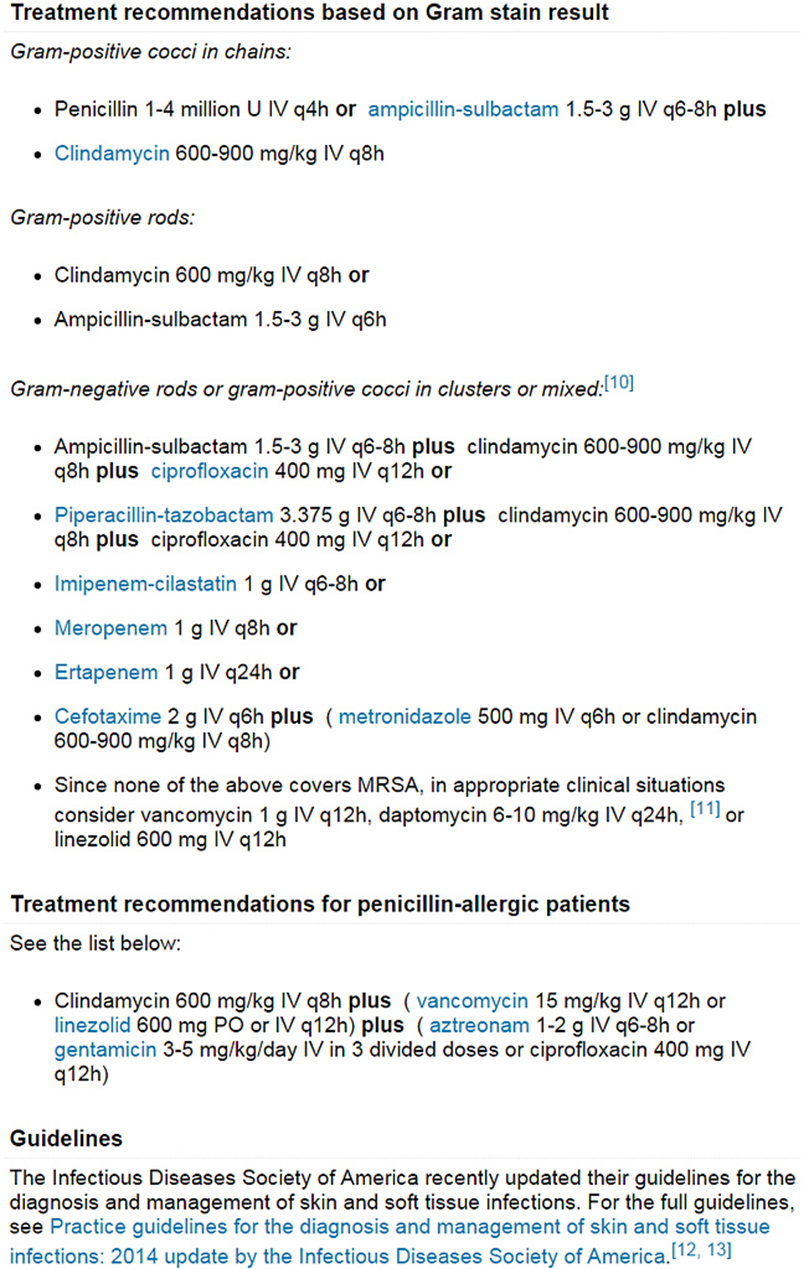
Treatment recommendations based on Gram stain result
Gram-positive cocci in chains:
· Penicillin 1-4 million U IV q4h or ampicillin-sulbactam 1.5-3 g IV q6-8h plus
· Clindamycin 600-900 mg/kg IV q8h
Gram-positive rods:
· Clindamycin 600 mg/kg IV q8h or
· Ampicillin-sulbactam 1.5-3 g IV q6h
Gram-negative rods or gram-positive cocci in clusters or mixed:[10]
· Ampicillin-sulbactam 1.5-3 g IV q6-8h plus clindamycin 600-900 mg/kg IV q8h plus ciprofloxacin 400 mg IV q12h or
· Piperacillin-tazobactam 3.375 g IV q6-8h plus clindamycin 600-900 mg/kg IV q8h plus ciprofloxacin 400 mg IV q12h or
· Imipenem-cilastatin 1 g IV q6-8h or
· Meropenem 1 g IV q8h or
· Ertapenem 1 g IV q24h or
· Cefotaxime 2 g IV q6h plus ( metronidazole 500 mg IV q6h or clindamycin 600-900 mg/kg IV q8h)
· Since none of the above covers MRSA, in appropriate clinical situations consider vancomycin 1 g IV q12h, daptomycin 6-10 mg/kg IV q24h, [11] or linezolid 600 mg IV q12h
Treatment recommendations for penicillin-allergic patients
See the list below:
· Clindamycin 600 mg/kg IV q8h plus ( vancomycin 15 mg/kg IV q12h orlinezolid 600 mg PO or IV q12h) plus ( aztreonam 1-2 g IV q6-8h orgentamicin 3-5 mg/kg/day IV in 3 divided doses or ciprofloxacin 400 mg IV q12h)
Guidelines
The Infectious Diseases Society of America recently updated their guidelines for the diagnosis and management of skin and soft tissue infections. For the full guidelines, see Practice guidelines for the diagnosis and management of skin and soft tissue infections: 2014 update by the Infectious Diseases Society of America.[12, 13]
嚴重低血鈣處置 Severe symptomatic and/or acute hypocalcemia
2023-08-10 17:42
下面資料來自uptodate(僅節錄部分), 中文是先用google翻譯之後再修改.
嚴重症狀和/或急性低鈣血症 — 我們建議靜脈注射 (IV) 鈣劑治療以下患者的低鈣血症(流程圖 1):
●症狀(例如手足痙攣、喉痙攣、支氣管痙攣、癲癇發作)
●QT間期延長
●A prolonged QT interval
or
應密切監測接受地高辛治療的患者,最好通過遙測技術監測急性洋地黃毒性,這種毒性可因靜脈輸注鈣劑而發生。然而,一項對 23 名患者的回顧性圖表審查發現,靜脈注射鈣不會導致地高辛中毒患者出現惡性心律失常或死亡率增加 [ 4 ]。
Patients receiving digoxin should be monitored closely, preferably with telemetry, for acute digitalis toxicity, which can develop with IV calcium infusion. However, one retrospective chart review of 23 patients found that IV calcium did not cause malignant dysrhythmias or increased mortality in digoxin-intoxicated patients [4].
對於無症狀或患有慢性穩定低鈣血症且僅有輕微症狀(例如感覺異常)的慢性腎病患者,不建議將靜脈鈣作為初始治療。對於慢性腎病患者,糾正高磷血症和低循環 1,25-二羥基維生素 D 通常是首要目標。(參見 “成人慢性腎髒病患者高磷血症的治療”和 “成人透析患者繼發性甲狀旁腺功能亢進症的治療”和 “成人非透析慢性腎髒病患者繼發性甲狀旁腺功能亢進症的治療” )
IV calcium is not warranted as initial therapy in patients with chronic kidney disease who are asymptomatic or who have chronic stable hypocalcemia with only mild symptoms (eg, paresthesias). In patients with chronic kidney disease, correction of hyperphosphatemia and of low circulating 1,25-dihydroxyvitamin D are usually the primary goals. (See "Management of hyperphosphatemia in adults with chronic kidney disease" and "Management of secondary hyperparathyroidism in adult dialysis patients" and "Management of secondary hyperparathyroidism in adult nondialysis patients with chronic kidney disease".)
靜脈鈣給藥 — 最初,可以在 10 至 20 分鐘內輸注靜脈鈣(1 或 2 g葡萄糖酸鈣,相當於 90 或 180 mg 元素鈣,溶於 50 mL 5% 葡萄糖或生理鹽水) 。如果需要緩解症狀,可在 10 至 60 分鐘後重複推注。不應更快地給予鈣,因為存在嚴重心功能障礙的風險,包括收縮期驟停[ 5 ]。推注葡萄糖酸鈣只會使血清鈣濃度升高兩到三個小時;因此,對於持續性低鈣血症患者,應緩慢輸注鈣。
Intravenous calcium dosing — Initially, IV calcium (1 or 2 g of calcium gluconate, equivalent to 90 or 180 mg elemental calcium, in 50 mL of 5% dextrose or normal saline) can be infused over 10 to 20 minutes. The bolus may be repeated after 10 to 60 minutes, if needed to resolve symptoms. The calcium should not be given more rapidly, because of the risk of serious cardiac dysfunction, including systolic arrest [5]. The bolus dose of calcium gluconate will raise the serum calcium concentration for only two or three hours; as a result, it should be followed by a slow infusion of calcium in patients with persistent hypocalcemia.
可以使用10%葡萄糖酸鈣溶液(每 10 mL 含有 90 mg 元素鈣)來製備連續輸注。葡萄糖酸鈣優於氯化鈣,因為如果外滲,它不太可能導致組織壞死。如果沒有葡萄糖酸鈣,可以使用 10% 氯化鈣溶液(每 10 毫升含 270 毫克元素鈣)作為替代方案。
A solution of 10% calcium gluconate (90 mg of elemental calcium per 10 mL) can be used to prepare the continuous infusion. Calcium gluconate is preferred to calcium chloride because it is less likely to cause tissue necrosis if extravasated. A solution of 10% calcium chloride (270 mg of elemental calcium per 10 mL) is an alternative if calcium gluconate is unavailable.
將 11 g 葡萄糖酸鈣(相當於 1000 mg 元素鈣)添加到生理鹽水或5% 葡萄糖水中以提供 1000 mL 的最終體積,製備含有 1 mg/mL 元素鈣的 IV 溶液。該溶液的初始輸注速度為 50 mL/小時(相當於 50 mg 元素鈣/小時)。可以調整劑量以將血清鈣濃度維持在正常範圍的下限(如上所述根據血清白蛋白的任何異常校正血清鈣)。患者通常每小時需要 0.5 至 1.5 毫克/公斤的元素鈣。
An IV solution containing 1 mg/mL of elemental calcium is prepared by adding 11 g of calcium gluconate (equivalent to 1000 mg elemental calcium) to normal saline or 5% dextrose water to provide a final volume of 1000 mL. This solution is administered at an initial infusion rate of 50 mL/hour (equivalent to 50 mg elemental calcium/hour). The dose can be adjusted to maintain the serum calcium concentration at the lower end of the normal range (with the serum calcium corrected for any abnormalities in serum albumin as noted above). Patients typically require 0.5 to 1.5 mg/kg of elemental calcium per hour.
準備輸液時應考慮以下因素:
●鈣應在葡萄糖和水或鹽水中稀釋,因為濃鈣溶液會刺激靜脈。
The infusion should be prepared with the following considerations:
●The calcium should be diluted in dextrose and water or saline because concentrated calcium solutions are irritating to veins.
●靜脈注射溶液不應含有碳酸氫鹽或磷酸鹽,它們會形成不溶性鈣鹽。如果需要這些陰離子,應使用另一條靜脈輸液管(在另一肢)。
●The IV solution should not contain bicarbonate or phosphate, which can form insoluble calcium salts. If these anions are needed, another IV line (in another limb) should be used.
應繼續靜脈補鈣,直至患者接受口服鈣和維生素 D 的有效治療方案。對於急性甲狀旁腺功能減退症患者,可使用骨化三醇(劑量為0.25至0.5 微克,每日兩次)和口服鈣(1 至4 克元素鈣)應盡快開始服用(每天分次服用)。骨化三醇是嚴重急性低鈣血症患者的首選維生素 D 製劑,因為其起效快(數小時)。急性和慢性甲狀旁腺功能減退症的治療詳見其他專題。
IV calcium should be continued until the patient is receiving an effective regimen of oral calcium and vitamin D. For patients with acute hypoparathyroidism, calcitriol (in a dose of 0.25 to 0.5 mcg twice daily) and oral calcium (1 to 4 g of elemental calcium carbonate daily in divided doses) should be initiated as soon as possible. Calcitriol is the preferred preparation of vitamin D for patients with severe acute hypocalcemia because of its rapid onset of action (hours). The management of acute and chronic hypoparathyroidism are reviewed in more detail separately.
下面資料來自uptodate(僅節錄部分), 中文是先用google翻譯之後再修改.
嚴重症狀和/或急性低鈣血症 — 我們建議靜脈注射 (IV) 鈣劑治療以下患者的低鈣血症(流程圖 1):
●症狀(例如手足痙攣、喉痙攣、支氣管痙攣、癲癇發作)
●QT間期延長
Severe symptomatic and/or acute hypocalcemia — We recommend intravenous (IV) calcium for the treatment of hypocalcemia in patients with (algorithm 1):
●Symptoms (eg, carpopedal spasm, laryngospasm, bronchospasm, seizures)●A prolonged QT interval
or
●血清校正鈣急劇下降至≤7.5 mg/dL(≤1.9 mmol/L)的無症狀患者,如果不治療可能會出現嚴重並發症。在離子鈣測定中,正常範圍為 4.8 至 5.6 mg/dL(1.2 至 1.4 mmol/L),閾值約為 ≤3 mg/dL(≤0.8 mmol/L)。當血清鈣快速、進行性降低時,可能會發生急性低鈣血症(例如,頭頸癌根治性頸清掃術後出現急性甲狀旁腺功能減退症)。
●In asymptomatic patients with an acute decrease in serum corrected calcium to ≤7.5 mg/dL (≤1.9 mmol/L), who may develop serious complications if untreated. In an ionized calcium assay with a normal range of 4.8 to 5.6 mg/dL (1.2 to 1.4 mmol/L), the threshold is approximately ≤3 mg/dL (≤0.8 mmol/L). Acute hypocalcemia can occur when there is a rapid and progressive reduction in serum calcium (eg, acute hypoparathyroidism following radical neck dissection for head and neck cancer).
●In asymptomatic patients with an acute decrease in serum corrected calcium to ≤7.5 mg/dL (≤1.9 mmol/L), who may develop serious complications if untreated. In an ionized calcium assay with a normal range of 4.8 to 5.6 mg/dL (1.2 to 1.4 mmol/L), the threshold is approximately ≤3 mg/dL (≤0.8 mmol/L). Acute hypocalcemia can occur when there is a rapid and progressive reduction in serum calcium (eg, acute hypoparathyroidism following radical neck dissection for head and neck cancer).
應密切監測接受地高辛治療的患者,最好通過遙測技術監測急性洋地黃毒性,這種毒性可因靜脈輸注鈣劑而發生。然而,一項對 23 名患者的回顧性圖表審查發現,靜脈注射鈣不會導致地高辛中毒患者出現惡性心律失常或死亡率增加 [ 4 ]。
Patients receiving digoxin should be monitored closely, preferably with telemetry, for acute digitalis toxicity, which can develop with IV calcium infusion. However, one retrospective chart review of 23 patients found that IV calcium did not cause malignant dysrhythmias or increased mortality in digoxin-intoxicated patients [4].
對於無症狀或患有慢性穩定低鈣血症且僅有輕微症狀(例如感覺異常)的慢性腎病患者,不建議將靜脈鈣作為初始治療。對於慢性腎病患者,糾正高磷血症和低循環 1,25-二羥基維生素 D 通常是首要目標。(參見 “成人慢性腎髒病患者高磷血症的治療”和 “成人透析患者繼發性甲狀旁腺功能亢進症的治療”和 “成人非透析慢性腎髒病患者繼發性甲狀旁腺功能亢進症的治療” )
IV calcium is not warranted as initial therapy in patients with chronic kidney disease who are asymptomatic or who have chronic stable hypocalcemia with only mild symptoms (eg, paresthesias). In patients with chronic kidney disease, correction of hyperphosphatemia and of low circulating 1,25-dihydroxyvitamin D are usually the primary goals. (See "Management of hyperphosphatemia in adults with chronic kidney disease" and "Management of secondary hyperparathyroidism in adult dialysis patients" and "Management of secondary hyperparathyroidism in adult nondialysis patients with chronic kidney disease".)
靜脈鈣給藥 — 最初,可以在 10 至 20 分鐘內輸注靜脈鈣(1 或 2 g葡萄糖酸鈣,相當於 90 或 180 mg 元素鈣,溶於 50 mL 5% 葡萄糖或生理鹽水) 。如果需要緩解症狀,可在 10 至 60 分鐘後重複推注。不應更快地給予鈣,因為存在嚴重心功能障礙的風險,包括收縮期驟停[ 5 ]。推注葡萄糖酸鈣只會使血清鈣濃度升高兩到三個小時;因此,對於持續性低鈣血症患者,應緩慢輸注鈣。
Intravenous calcium dosing — Initially, IV calcium (1 or 2 g of calcium gluconate, equivalent to 90 or 180 mg elemental calcium, in 50 mL of 5% dextrose or normal saline) can be infused over 10 to 20 minutes. The bolus may be repeated after 10 to 60 minutes, if needed to resolve symptoms. The calcium should not be given more rapidly, because of the risk of serious cardiac dysfunction, including systolic arrest [5]. The bolus dose of calcium gluconate will raise the serum calcium concentration for only two or three hours; as a result, it should be followed by a slow infusion of calcium in patients with persistent hypocalcemia.
可以使用10%葡萄糖酸鈣溶液(每 10 mL 含有 90 mg 元素鈣)來製備連續輸注。葡萄糖酸鈣優於氯化鈣,因為如果外滲,它不太可能導致組織壞死。如果沒有葡萄糖酸鈣,可以使用 10% 氯化鈣溶液(每 10 毫升含 270 毫克元素鈣)作為替代方案。
A solution of 10% calcium gluconate (90 mg of elemental calcium per 10 mL) can be used to prepare the continuous infusion. Calcium gluconate is preferred to calcium chloride because it is less likely to cause tissue necrosis if extravasated. A solution of 10% calcium chloride (270 mg of elemental calcium per 10 mL) is an alternative if calcium gluconate is unavailable.
將 11 g 葡萄糖酸鈣(相當於 1000 mg 元素鈣)添加到生理鹽水或5% 葡萄糖水中以提供 1000 mL 的最終體積,製備含有 1 mg/mL 元素鈣的 IV 溶液。該溶液的初始輸注速度為 50 mL/小時(相當於 50 mg 元素鈣/小時)。可以調整劑量以將血清鈣濃度維持在正常範圍的下限(如上所述根據血清白蛋白的任何異常校正血清鈣)。患者通常每小時需要 0.5 至 1.5 毫克/公斤的元素鈣。
An IV solution containing 1 mg/mL of elemental calcium is prepared by adding 11 g of calcium gluconate (equivalent to 1000 mg elemental calcium) to normal saline or 5% dextrose water to provide a final volume of 1000 mL. This solution is administered at an initial infusion rate of 50 mL/hour (equivalent to 50 mg elemental calcium/hour). The dose can be adjusted to maintain the serum calcium concentration at the lower end of the normal range (with the serum calcium corrected for any abnormalities in serum albumin as noted above). Patients typically require 0.5 to 1.5 mg/kg of elemental calcium per hour.
準備輸液時應考慮以下因素:
●鈣應在葡萄糖和水或鹽水中稀釋,因為濃鈣溶液會刺激靜脈。
The infusion should be prepared with the following considerations:
●The calcium should be diluted in dextrose and water or saline because concentrated calcium solutions are irritating to veins.
●靜脈注射溶液不應含有碳酸氫鹽或磷酸鹽,它們會形成不溶性鈣鹽。如果需要這些陰離子,應使用另一條靜脈輸液管(在另一肢)。
●The IV solution should not contain bicarbonate or phosphate, which can form insoluble calcium salts. If these anions are needed, another IV line (in another limb) should be used.
應繼續靜脈補鈣,直至患者接受口服鈣和維生素 D 的有效治療方案。對於急性甲狀旁腺功能減退症患者,可使用骨化三醇(劑量為0.25至0.5 微克,每日兩次)和口服鈣(1 至4 克元素鈣)應盡快開始服用(每天分次服用)。骨化三醇是嚴重急性低鈣血症患者的首選維生素 D 製劑,因為其起效快(數小時)。急性和慢性甲狀旁腺功能減退症的治療詳見其他專題。
IV calcium should be continued until the patient is receiving an effective regimen of oral calcium and vitamin D. For patients with acute hypoparathyroidism, calcitriol (in a dose of 0.25 to 0.5 mcg twice daily) and oral calcium (1 to 4 g of elemental calcium carbonate daily in divided doses) should be initiated as soon as possible. Calcitriol is the preferred preparation of vitamin D for patients with severe acute hypocalcemia because of its rapid onset of action (hours). The management of acute and chronic hypoparathyroidism are reviewed in more detail separately.
氫氟酸中毒 HF EXPOSURE TREATMENT GUIDE FOR PHYSICIANS
2023-08-10 重貼
以前學到的是可以將 gel 放在醫用手套裡面. 請病人戴手套. 讓皮膚可以持續接觸gel
還有就是病患不一定在暴露當下就來掛急診.
氫氟酸的工業用途是酸洗金屬表面. 所以電鍍工廠會用到.
有些病患是在工廠少量持續暴露一整天. 下班才來掛急診
國科會-科技大觀園-蝕骨水解密:氫氟酸
以前學到的是可以將 gel 放在醫用手套裡面. 請病人戴手套. 讓皮膚可以持續接觸gel
還有就是病患不一定在暴露當下就來掛急診.
氫氟酸的工業用途是酸洗金屬表面. 所以電鍍工廠會用到.
有些病患是在工廠少量持續暴露一整天. 下班才來掛急診
如果是大面積 160 平方公分 (大約13公分正方形)暴露可能導致急性低血鈣. 鈣離子過低除了會造成肌肉痙攣, 感覺異常, 還會引起 QT prolong. 進一步導致心律不整.
(嚴重低血鈣處置另外寫一篇: )
(嚴重低血鈣處置另外寫一篇: )
國科會-科技大觀園-蝕骨水解密:氫氟酸
氫氟酸的用途非常廣泛,不僅是清潔業裡常用的清洗劑,製作不鏽鋼、非鐵金屬的過程中,也用氫氟酸清洗表面含氧化物與鏽蝕物(即酸洗),更是石化製程中重要的催化劑。 值得關注的是,氫氟酸亦是半導體、面板、太陽能電池等產業製程中,用於清洗與蝕刻製程最常用的化學溶液之一。
參考資料-- 下面中文是google翻譯
201602022306HF EXPOSURE TREATMENT GUIDE FOR PHYSICIANS
HF EXPOSURE TREATMENT GUIDE FOR PHYSICIANS
參考資料-- 下面中文是google翻譯
201602022306HF EXPOSURE TREATMENT GUIDE FOR PHYSICIANS
HF EXPOSURE TREATMENT GUIDE FOR PHYSICIANS
University of Southern California Environmental Health and Safety
醫師版-暴露治療指南
簡介
氟化氫是一種高腐蝕性化學品,接觸後會導致嚴重深度燒傷。必須為任何接觸 HF 的人提供醫療援助並立即開始治療。氟化氫與其他腐蝕性化學物質的不同之處在於,氟離子很容易滲透皮膚,導致包括骨骼在內的深層組織層遭到破壞。然而,其嚴重的有害作用來自氟化物(F-)的作用,而不是酸燒傷。HF 中的氟化鐵與骨骼中的 Ca2+ 形成如此牢固的結合。它到達骨骼並從骨骼中濾出鈣,並可能將鈣束縛在神經細胞中。當破壞心臟功能時,這種神經狀況的破壞可能會危及生命。
HF Exposure Treatment Guide for Physicians
Introduction
Hydrogen fluoride is a highly corrosive chemical that can cause severe and deep burns on exposure. It is imperative that medical assistance be provided for any exposure to HF and the treatment be initiated promptly. Hydrogen fluoride differs from other corrosive chemicals in that the fluoride ion readily penetrates the skin causing destruction of deep tissue layers including bone. However, its critical harmful effect comes from the action of the fluoride (F-), not acid burn. Fluoride iron from HF forms such a strong bond to Ca2+ in bones. It reaches to bones and leaches calcium from bones and may tie up calcium in nerve cell. This disruption of nerve condition can be life threatening when disrupting a heart function.
皮膚接觸
局部使用的葡萄糖酸鈣凝膠(2.5%)必須持續塗抹,直至疼痛完全消退。用水徹底(至少 15 分鐘)清洗皮膚後才能使用葡萄糖酸鈣凝膠。疼痛消退後,每隔 3 或 4 小時擦一次葡萄糖酸鈣凝膠,每次 30 分鐘。如果皮膚深度或廣泛燒傷,應將 2.5% 葡萄糖酸鈣凝膠按摩到皮膚上,持續 3 至 4 天,每天 4 至 6 次。應注意塗抹凝膠的人員,尤其是初次塗抹時,應佩戴橡膠手套,以防止皮膚被氫氟酸污染以及可能發生的手部灼傷。
Skin contact
Topically applied calcium gluconate gel (2.5 percent) must be rubbed-in continuously until pain has completely subsided. Calcium gluconate gel should not be used until after complete (at least 15 minutes) washing of the skin with water. After the pain has subsided, the calcium gluconate gel should be rubbed-in for 30 minutes at 3 or 4 hour intervals. If the skin burns are deep or extensive, calcium gluconage gel, 2.5%, should be massaged into the skin for 3 to 4 days, 4 to 6 times daily. Care should be taken to see that personnel who apply the gel, especially on the initial application, wear rubber gloves to prevent skin contamination with HF and possible development of hand burns.
如果皮膚燒傷面積大於 25 平方英寸(160 平方厘米),可能會出現低鈣血症。因此,系統性施用葡萄糖酸鈣可能是必要的。經常監測血清鈣、腎和肝功能是必要的。
In cases where skin burns are greater than 25 square inches (160 cm2) in area, hypocalcemia may be present. Therefore, systematic administration of calcium gluconate may be necessary. Frequent monitoring of serum calcium, renal and hepatic functions is necessary.
當二度或三度燒傷有皮膚穿透跡象時,可採用與註射葡萄糖酸鈣溶液相同的方式,將5%葡萄糖酸鈣溶液(靜脈使用的標準安瓿為10%)注入皮膚和皮下組織。局部麻醉劑。應注意避免過量服用鈣。所有暴露的皮膚都應被滲透,包括該區域周圍 6 毫米(1/4 英寸)的範圍。這可以防止嚴重燒傷的發生。
When there is evidence of skin penetration as in second or third degree burns, a 5 percent calcium gluconate solution (the standard ampule is 10 percent for intravenous use) may be injected by infiltrating the skin and subcutaneous tissues in the same manner as the injection of a local anesthetic. Care should be taken to avoid overdosing with calcium. All skin which has been exposed should be infiltrated including up to ¼ inch (6 mm) around the area. This may prevent the development of severe burns.
指甲周圍的燒傷可能需要將指甲從遠端劈開,以減輕疼痛并促進排水,然後再用上述溶液之一浸泡。
Burns around the fingernail may require splitting the nail from the distal end in order to relieve pain and facilitate draining prior to soaking with one of the above-mentioned solutions.
立即切除用濃縮氫氟酸溶液燒傷的小面積區域可以防止疼痛且癒合緩慢的燒傷。如果有需要的話,切除植皮後進行一期閉合可以提供更快的癒合和更少的疤痕。
Immediate excision of small areas burned with concentrated solutions of HF may prevent a painful, slow-healing burn. Primary closure after excision of skin grafting, if indicated, may provide more rapid healing and less scarring.
眼睛接觸(google翻譯成眼神)
立即用大量水清洗眼睛,同時將眼瞼分開至少 15 分鐘,然後用冰袋敷上。應使用冰袋直至到達醫療機構。此時,應使用1%葡萄糖酸鈣生理鹽水徹底沖洗眼睛5至10分鐘,此後每兩或三個小時滴注葡萄糖酸鈣生理鹽水一次,持續48至72小時。不得使用油或藥膏。使用眼用皮質類固醇溶液可以減少炎症。應立即諮詢眼科專家。
Eye Contact
Immediate washing of the eyes with large quantities of water while holding eyelids apart for at least 15 minutes should be followed by ice packs. The ice packs should be used until a medical facility is reached. Here the eyes should be washed thoroughly with 1 percent calcium gluconate in normal, sterile saline for 5 to 10 minutes, thereafter, calcium gluconate in normal saline should be instilled every two or three hours for 48 to 72 hours. No oils or ointments should be used. Inflammation may be decreased by the use of corticosteroid solutions for ophthalmic use. An eye specialist should be consulted immediately.
蒸氣吸入
應通過面罩或導管向吸入 HF 的人員提供 100% 的氧氣。應盡快通過吸入方式給予他們 2.5% 至 3% 的葡萄糖酸鈣溶液,最好使用霧化器進行間歇性正壓呼吸 (IPPB),或單獨使用霧化器。應仔細觀察患者有無上氣道水腫伴呼吸阻塞,必要時通過氣管切開或氣管插管維持氣道。
Vapor Inhalation
Persons exposed to HF by inhalation should be given 100 percent oxygen by mask or catheter. As soon as possible, they should be given 2.5 to 3 percent calcium gluconate solution by inhalation, preferably by intermittent Positive Pressure Breathing (IPPB) utilizing a nebulizer, or by nebulizer alone. The patient should be carefully watched for edema of the upper airway with respiratory obstruction and the airway maintained by tracheostomy or endotracheal intubation if necessary.
如果出現肺水腫,應將患者置於呼氣正壓 (PEEP) 的 IPPB 上。應密切監督呼吸系統護理,包括吸入葡萄糖酸鈣。肺部吸收氟離子引起的毒性可能會在肝臟和腎臟中迅速發展,如果血液尿素氮和鉀升高,可能需要採取更有力的控制措施,直至並包括血液透析。支持治療對於所有器官系統都是必要的。
If pulmonary edema develops, the patient should be placed on IPPB with Positive Expiratory Pressure (PEEP). The administration of respiratory care should be very closely supervised, including the administration of calcium gluconate by inhalation. Toxicity from pulmonary absorption of fluoride ion may rapidly develop in the liver and kidneys and may require more energetic measure of control, up to and including hemodialysis, if the blood urea nitrogen and potassium rise. Supportive care is necessary for all organ systems.
食入
根據需要採取急救措施,包括讓患者飲用大量牛奶或添加氧化鎂乳的水。不要催吐。喉嚨燒傷可能會導致嚴重腫脹,需要進行氣管切開術。應將患者送往醫院並仔細觀察。
Ingestion
Apply first aid measures as needed, including having the patient drink a large quantity of milk or water with added milk of magnesia. Do not induce vomiting. Throat burns may cause severe swelling and require a tracheostomy. The patient should be administered to the hospital and carefully watched.
醫療用品
葡萄糖酸鈣凝膠,2.5 %
(強烈建議在工作現場保留商業級葡萄糖酸鈣凝膠以備緊急情況)
葡萄糖酸鈣,1 % 正常無菌鹽水溶液
葡萄糖酸鈣,10 % 用於注射(標準安瓿)。使用等量葡萄糖酸鈣和無菌生理鹽水混合的 5% 溶液。
Medical Supplies
Calcium gluoconate gel, 2.5 %
(Keeping a commercial grade calcium gluconate gel at the work site is highly recommended for an emergency)
Calcium gluconate, 1 % normal, sterile saline solution
Calcium gluconate, 10 % for injecting (standard ampule). Use 5 percent solution mixing equal quantities of calcium gluconate and sterile normal saline.
要製備用於高頻燒傷皮下注射的 5% 葡萄糖酸鈣溶液,請將等量的無菌 10% 葡萄糖酸鈣溶液和無菌生理鹽水混合。
要製備供霧化器吸入的 2.5% 葡萄糖酸鈣溶液,請將一份 10% 葡萄糖酸鈣與三份無菌生理鹽水混合。
25cc 10% 葡萄糖酸鈣加 225cc 生理鹽水 = 1% 滴眼液
To make a 5 % solution of calcium gluconate for subcutaneous injection in HF burns, mix equal amounts of sterile 10% calcium gluconate solution and sterile normal saline.
To make a 2.5% solution of calcium gluconate for inhalation exposure to be given by nebulizer, mix one part of 10% calcium gluconate with three parts of sterile normal saline.
25cc 10% calcium gluconate with 225cc normal saline = 1% eye solution
製備葡萄糖酸鈣凝膠
將定量的 KY Jelly (Johnson & Johnson) 加熱至 50-60oC,通常為 395 克
添加按重量計2.5% 的葡萄糖酸鈣,試劑級,緩慢地充分攪拌直至全部溶解。
Preparation of Calcium Gluconate Gel
Heat a measured amount of K-Y Jelly (Johnson & Johnson) to 50-60oC, typically 395 gram
Add 2.5% by weight of calcium gluconate, reagent grade, slowly with good stirring until all dissolved.
An alternate method of adding the calcium gluconate is to add 2 grams and stir in until mostly dissolved, then add the remaining calcium gluconate (added to 35 cc of H2O)) with good stirring until dissolved into the jelly
透明含有許多氣泡,靜置後可以通過讓氣泡上升到表面來去除
Finished gel will be water-clear with many air bubbles which can be removed by allowing the bubbles to rise to the surface after standing
上述數量將填滿十一個四盎司罐子,大約四分之三滿
The above quantities will fill eleven four ounce jars approximately three quarters full
Additional Information
Article: M.A. Trevino et al, J. Occ. Med., 25, p. 861
Product Information, EI. DuPont De Nemours & Company, 1-800-441-7515 (product) or 3637 (medical assistance)
醫師版-暴露治療指南
簡介
氟化氫是一種高腐蝕性化學品,接觸後會導致嚴重深度燒傷。必須為任何接觸 HF 的人提供醫療援助並立即開始治療。氟化氫與其他腐蝕性化學物質的不同之處在於,氟離子很容易滲透皮膚,導致包括骨骼在內的深層組織層遭到破壞。然而,其嚴重的有害作用來自氟化物(F-)的作用,而不是酸燒傷。HF 中的氟化鐵與骨骼中的 Ca2+ 形成如此牢固的結合。它到達骨骼並從骨骼中濾出鈣,並可能將鈣束縛在神經細胞中。當破壞心臟功能時,這種神經狀況的破壞可能會危及生命。
HF Exposure Treatment Guide for Physicians
Introduction
Hydrogen fluoride is a highly corrosive chemical that can cause severe and deep burns on exposure. It is imperative that medical assistance be provided for any exposure to HF and the treatment be initiated promptly. Hydrogen fluoride differs from other corrosive chemicals in that the fluoride ion readily penetrates the skin causing destruction of deep tissue layers including bone. However, its critical harmful effect comes from the action of the fluoride (F-), not acid burn. Fluoride iron from HF forms such a strong bond to Ca2+ in bones. It reaches to bones and leaches calcium from bones and may tie up calcium in nerve cell. This disruption of nerve condition can be life threatening when disrupting a heart function.
皮膚接觸
局部使用的葡萄糖酸鈣凝膠(2.5%)必須持續塗抹,直至疼痛完全消退。用水徹底(至少 15 分鐘)清洗皮膚後才能使用葡萄糖酸鈣凝膠。疼痛消退後,每隔 3 或 4 小時擦一次葡萄糖酸鈣凝膠,每次 30 分鐘。如果皮膚深度或廣泛燒傷,應將 2.5% 葡萄糖酸鈣凝膠按摩到皮膚上,持續 3 至 4 天,每天 4 至 6 次。應注意塗抹凝膠的人員,尤其是初次塗抹時,應佩戴橡膠手套,以防止皮膚被氫氟酸污染以及可能發生的手部灼傷。
Skin contact
Topically applied calcium gluconate gel (2.5 percent) must be rubbed-in continuously until pain has completely subsided. Calcium gluconate gel should not be used until after complete (at least 15 minutes) washing of the skin with water. After the pain has subsided, the calcium gluconate gel should be rubbed-in for 30 minutes at 3 or 4 hour intervals. If the skin burns are deep or extensive, calcium gluconage gel, 2.5%, should be massaged into the skin for 3 to 4 days, 4 to 6 times daily. Care should be taken to see that personnel who apply the gel, especially on the initial application, wear rubber gloves to prevent skin contamination with HF and possible development of hand burns.
如果皮膚燒傷面積大於 25 平方英寸(160 平方厘米),可能會出現低鈣血症。因此,系統性施用葡萄糖酸鈣可能是必要的。經常監測血清鈣、腎和肝功能是必要的。
In cases where skin burns are greater than 25 square inches (160 cm2) in area, hypocalcemia may be present. Therefore, systematic administration of calcium gluconate may be necessary. Frequent monitoring of serum calcium, renal and hepatic functions is necessary.
當二度或三度燒傷有皮膚穿透跡象時,可採用與註射葡萄糖酸鈣溶液相同的方式,將5%葡萄糖酸鈣溶液(靜脈使用的標準安瓿為10%)注入皮膚和皮下組織。局部麻醉劑。應注意避免過量服用鈣。所有暴露的皮膚都應被滲透,包括該區域周圍 6 毫米(1/4 英寸)的範圍。這可以防止嚴重燒傷的發生。
When there is evidence of skin penetration as in second or third degree burns, a 5 percent calcium gluconate solution (the standard ampule is 10 percent for intravenous use) may be injected by infiltrating the skin and subcutaneous tissues in the same manner as the injection of a local anesthetic. Care should be taken to avoid overdosing with calcium. All skin which has been exposed should be infiltrated including up to ¼ inch (6 mm) around the area. This may prevent the development of severe burns.
指甲周圍的燒傷可能需要將指甲從遠端劈開,以減輕疼痛并促進排水,然後再用上述溶液之一浸泡。
Burns around the fingernail may require splitting the nail from the distal end in order to relieve pain and facilitate draining prior to soaking with one of the above-mentioned solutions.
立即切除用濃縮氫氟酸溶液燒傷的小面積區域可以防止疼痛且癒合緩慢的燒傷。如果有需要的話,切除植皮後進行一期閉合可以提供更快的癒合和更少的疤痕。
Immediate excision of small areas burned with concentrated solutions of HF may prevent a painful, slow-healing burn. Primary closure after excision of skin grafting, if indicated, may provide more rapid healing and less scarring.
眼睛接觸(google翻譯成眼神)
立即用大量水清洗眼睛,同時將眼瞼分開至少 15 分鐘,然後用冰袋敷上。應使用冰袋直至到達醫療機構。此時,應使用1%葡萄糖酸鈣生理鹽水徹底沖洗眼睛5至10分鐘,此後每兩或三個小時滴注葡萄糖酸鈣生理鹽水一次,持續48至72小時。不得使用油或藥膏。使用眼用皮質類固醇溶液可以減少炎症。應立即諮詢眼科專家。
Eye Contact
Immediate washing of the eyes with large quantities of water while holding eyelids apart for at least 15 minutes should be followed by ice packs. The ice packs should be used until a medical facility is reached. Here the eyes should be washed thoroughly with 1 percent calcium gluconate in normal, sterile saline for 5 to 10 minutes, thereafter, calcium gluconate in normal saline should be instilled every two or three hours for 48 to 72 hours. No oils or ointments should be used. Inflammation may be decreased by the use of corticosteroid solutions for ophthalmic use. An eye specialist should be consulted immediately.
蒸氣吸入
應通過面罩或導管向吸入 HF 的人員提供 100% 的氧氣。應盡快通過吸入方式給予他們 2.5% 至 3% 的葡萄糖酸鈣溶液,最好使用霧化器進行間歇性正壓呼吸 (IPPB),或單獨使用霧化器。應仔細觀察患者有無上氣道水腫伴呼吸阻塞,必要時通過氣管切開或氣管插管維持氣道。
Vapor Inhalation
Persons exposed to HF by inhalation should be given 100 percent oxygen by mask or catheter. As soon as possible, they should be given 2.5 to 3 percent calcium gluconate solution by inhalation, preferably by intermittent Positive Pressure Breathing (IPPB) utilizing a nebulizer, or by nebulizer alone. The patient should be carefully watched for edema of the upper airway with respiratory obstruction and the airway maintained by tracheostomy or endotracheal intubation if necessary.
如果出現肺水腫,應將患者置於呼氣正壓 (PEEP) 的 IPPB 上。應密切監督呼吸系統護理,包括吸入葡萄糖酸鈣。肺部吸收氟離子引起的毒性可能會在肝臟和腎臟中迅速發展,如果血液尿素氮和鉀升高,可能需要採取更有力的控制措施,直至並包括血液透析。支持治療對於所有器官系統都是必要的。
If pulmonary edema develops, the patient should be placed on IPPB with Positive Expiratory Pressure (PEEP). The administration of respiratory care should be very closely supervised, including the administration of calcium gluconate by inhalation. Toxicity from pulmonary absorption of fluoride ion may rapidly develop in the liver and kidneys and may require more energetic measure of control, up to and including hemodialysis, if the blood urea nitrogen and potassium rise. Supportive care is necessary for all organ systems.
食入
根據需要採取急救措施,包括讓患者飲用大量牛奶或添加氧化鎂乳的水。不要催吐。喉嚨燒傷可能會導致嚴重腫脹,需要進行氣管切開術。應將患者送往醫院並仔細觀察。
Ingestion
Apply first aid measures as needed, including having the patient drink a large quantity of milk or water with added milk of magnesia. Do not induce vomiting. Throat burns may cause severe swelling and require a tracheostomy. The patient should be administered to the hospital and carefully watched.
醫療用品
葡萄糖酸鈣凝膠,2.5 %
(強烈建議在工作現場保留商業級葡萄糖酸鈣凝膠以備緊急情況)
葡萄糖酸鈣,1 % 正常無菌鹽水溶液
葡萄糖酸鈣,10 % 用於注射(標準安瓿)。使用等量葡萄糖酸鈣和無菌生理鹽水混合的 5% 溶液。
Medical Supplies
Calcium gluoconate gel, 2.5 %
(Keeping a commercial grade calcium gluconate gel at the work site is highly recommended for an emergency)
Calcium gluconate, 1 % normal, sterile saline solution
Calcium gluconate, 10 % for injecting (standard ampule). Use 5 percent solution mixing equal quantities of calcium gluconate and sterile normal saline.
要製備用於高頻燒傷皮下注射的 5% 葡萄糖酸鈣溶液,請將等量的無菌 10% 葡萄糖酸鈣溶液和無菌生理鹽水混合。
要製備供霧化器吸入的 2.5% 葡萄糖酸鈣溶液,請將一份 10% 葡萄糖酸鈣與三份無菌生理鹽水混合。
25cc 10% 葡萄糖酸鈣加 225cc 生理鹽水 = 1% 滴眼液
To make a 5 % solution of calcium gluconate for subcutaneous injection in HF burns, mix equal amounts of sterile 10% calcium gluconate solution and sterile normal saline.
To make a 2.5% solution of calcium gluconate for inhalation exposure to be given by nebulizer, mix one part of 10% calcium gluconate with three parts of sterile normal saline.
25cc 10% calcium gluconate with 225cc normal saline = 1% eye solution
製備葡萄糖酸鈣凝膠
將定量的 KY Jelly (Johnson & Johnson) 加熱至 50-60oC,通常為 395 克
添加按重量計2.5% 的葡萄糖酸鈣,試劑級,緩慢地充分攪拌直至全部溶解。
Preparation of Calcium Gluconate Gel
Heat a measured amount of K-Y Jelly (Johnson & Johnson) to 50-60oC, typically 395 gram
Add 2.5% by weight of calcium gluconate, reagent grade, slowly with good stirring until all dissolved.
An alternate method of adding the calcium gluconate is to add 2 grams and stir in until mostly dissolved, then add the remaining calcium gluconate (added to 35 cc of H2O)) with good stirring until dissolved into the jelly
透明含有許多氣泡,靜置後可以通過讓氣泡上升到表面來去除
Finished gel will be water-clear with many air bubbles which can be removed by allowing the bubbles to rise to the surface after standing
上述數量將填滿十一個四盎司罐子,大約四分之三滿
The above quantities will fill eleven four ounce jars approximately three quarters full
Additional Information
Article: M.A. Trevino et al, J. Occ. Med., 25, p. 861
Product Information, EI. DuPont De Nemours & Company, 1-800-441-7515 (product) or 3637 (medical assistance)
2023年8月9日 星期三
食物中毒 Food poisoning symptoms
2023-08-09 剛好看到有食物中毒新聞. 貼在最下面.
即2人或2人以上於一定期間內攝取相同食品,發生相同症狀,並且自可 疑的食餘檢體及患者糞便、嘔吐物、血液等人體檢體,或者其他有關環境檢體(如空氣、水、土壤)中分離出相同類型(如血清型、噬菌型)的致病原因,則稱為一件「食品中毒」,但如因攝食肉毒桿菌或急性化學性中毒時,雖只為1人,也視為一件「食品中毒」案件。
何時該就醫? 美國疾管署建議. 下列情況需考慮就醫(不是看急診. 是去看家庭醫師)
血便.
發燒超過 102 °F
脫水
頻繁嘔吐無法喝水
腹瀉超過三天
\

台灣疾管署--腹瀉群聚事件處理作業原則(上架)106年8月
前言
腹瀉通常是腸胃道感染的一種症狀,可由多種細菌、病毒或寄生蟲引 起,通常經由污染的食物或飲用水傳染,或透過人與人之間直接或間 接接觸而傳播。霍亂、傷寒/副傷寒、桿菌性痢疾、阿米巴痢疾及腸道 出血性大腸桿菌感染症等腹瀉傳染病,已依據傳染病防治法第 3 條規 定公告為第二類傳染病,而其他造成腹瀉的病原,例如諾羅病毒、輪 狀病毒、非傷寒沙門氏菌、非產毒性霍亂弧菌及腸炎弧菌等,其雖非 屬法定傳染病,但仍可引起群聚事件,影響國人健康,其所引發之群 聚事件,亦為國內傳染病防治之重點監測項目,爰訂定本處理作業原 則,以提供衛生機關處理腹瀉群聚事件,執行相關防疫措施之遵循依 據。
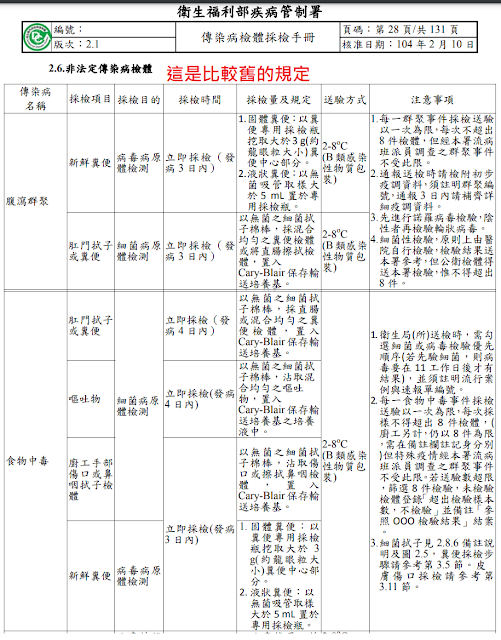
台灣疾管署. 傳染病檢體採檢手冊 2015年 2月編定

台灣食藥署-疑似食品中毒事件處理要點
中華民國109年3月9日FDA食字第10913000465號函修正
節錄部分
二、發生疑似食品中毒事件,醫療機構應依食品安全衛生管理法第六條規定於二十四小時內向當地主管機關報告。
三、當地衛生局於接到疑似食品中毒事件通報後,應即派員調查食品中毒發生經過,追查可疑食品來源及其貯藏、處理與烹調方法,並至食品中毒案件通報調查管理系統填寫「食品中毒事件調查簡速報告單」,傳送予相關衛生局及食品藥物管理署
(一)食品(藥)科(處、課)負責可疑食品來源及其製造場所之調查處理,包括供應食品場所之稽查輔導、食品製程、製造環境等。
(二) 主辦及協辦之地方政府衛生局分工原則如下:
1. 有下列情況者,應為主辦地方政府衛生局:
(1)涉嫌食品之食品供應者所在之縣市。
(2)可能涉嫌之食品供應者不只一處,則以首位就醫個案症狀發生前用餐場所之食品供應者所在之縣市。
2. 其它與案件相關之縣市為協辦地方政府衛生局。
(三)疑似食品中毒案件符合「中毒人數達50人或以上者」、「食品中毒事件有持續擴散之虞」、「社會大眾關注事件」、「病因物質特殊者(如肉毒桿菌、麻痺性貝類毒素等)」或「其他特殊因素」等原則,得填寫支援申請單向疾病管制署申請啟動流行病學調查(附件二),食品藥物管理署得派員參與調查。肉毒桿菌中毒通報案件,應依「疑似肉毒桿菌中毒案件處理原則」(附件三)處理。
四、疑似食品中毒事件相關檢體之採樣分工原則如下:
(一) 食品檢體(食餘、嫌疑食品等)及環境檢體(刀具、砧板、飲用水、洗滌水等):由衛生局食品(藥)科(處、課)主辦。
(二) 人體檢體包括患者糞便及廚工檢體(糞便、手部傷口等):由衛生局疾管科(處、課)主辦;疑似食品中毒事件有人體檢體送驗需求時,需由衛生局疾管科(處、課)至疾病管制署「症狀監視及預警系統」通報腹瀉群聚事件,並循此流程採檢送驗。
五、疑似食品中毒事件相關檢體之檢驗分工原則如下:
(一) 由衛生局檢驗單位(或食品藥物管理署認可機驗機構)進行食品及環境檢體檢驗。
(二) 由疾病管制署(或其認可檢驗機構)進行人體檢體檢驗。
(三) 衛生局檢驗單位因設備不足無法檢驗或有傳染性疾病之嫌疑時,且食品藥物管理署認可檢驗機構亦無法檢驗時,應儘速檢同「食品中毒事件調查簡速報告單」及相關檢體,以適當方法逕送中央主管機關檢驗。
(七)食品中毒事件,若未進行病原性生物之檢驗或經檢驗而未能檢驗出病原性生物時,仍可依患者之訪談紀錄及合格醫師之診斷,就具體事件應用流行病學之科學原理進行研判,結果明顯與某食品有因果關係且涉有嫌疑時,即應移送司法機關。
八、地方政府衛生局應將疑似食品中毒事件調查過程、檢驗資料及處理結果報告中央主管機關:
(一) 傳染病:由疾管科(處、課)彙整陳報。
(二) 食品中毒:由食品(藥)科(處、課)彙整陳報。
(三) 食品中毒事件由食品藥物管理署進行資料彙整及統計。
(四) 經研判為法定傳染病相關食品中毒事件,由食品藥物管理署與疾病管制署依分工發布新聞稿。
CDC: Food poisoning symptoms
You can get sick with food poisoning after swallowing certain germs, like Salmonella or E. coli. Your symptoms may vary, depending on the germ you swallowed. Symptoms can range from mild to serious and can last for a few hours or several days.
The most common symptoms of food poisoning are:
Diarrhea
Stomach pain or cramps
Nausea
Vomiting
Fever
If you have diarrhea or vomiting, be sure to drink plenty of fluids to prevent dehydration (not having enough water in your body).
Should I See a Doctor for Food Poisoning?
See a doctor if you have any symptoms that are severe, including
Bloody diarrhea
Diarrhea that lasts more than 3 days
High fever (temperature over 102°F)
Vomiting so often that you cannot keep liquids down
Signs of dehydration, which include not urinating (peeing) much, a dry mouth and throat, feeling dizzy when standing up
See your doctor if you are pregnant and have a fever and other flu-like symptoms. Some mild infections can cause problems with pregnancy.
知名越南法國麵包中毒案增至422人 衛生局揪這佐料出大包
桃園市中壢區忠貞市場人氣排隊名攤「阿箴越南法國麵包」食品中毒案再擴大,截至6日通報增至422人,市府衛生局調查,攤商疑似是製作蛋黃醬前,未落實雞蛋清潔導致這次食品中毒案,將依違反食品安全衛生管理法開罰業者54萬元罰鍰,另即日起啟動東南亞即時食品(冷食)稽查專案,全面稽查桃園市攤商食品安全。
衛生局說明,針對8月2日、3日有買過該攤法國麵包且有症狀者發出問卷調查,共計243人填寫,經統計有229人出現身體寒顫、發燒、噁心、嘔吐、腹瀉等症狀,潛伏期為4至63小時30分。另經醫院通報食品中毒民眾,有4人檢驗出沙門氏桿菌。此外,稽查人員前往稽查業者製備的食材,除發現冰箱溫度不足外,其中蛋類製品有滷鴨蛋及蛋黃醬,而蛋黃醬是在家製作完成後常溫送至攤位,疑似就是在製作蛋黃醬前未落實雞蛋清潔導致整起食品中毒案。
衛生局追蹤住院民眾,還有16人因腹瀉、腹痛、發燒、倦怠等症狀住院中,也提醒沙門氏菌是造成食品中毒常見的病菌,易受汙染的食物包含生的或未煮熟的雞蛋及雞蛋製品以及牛奶或乳製品,還有肉類等等,若食物保存不當,沙門氏菌易在高溫下大量繁殖也容易傳播,一般臨床症狀以急性腸胃炎為主,在感染後約6至48小時會有噁心、嘔吐及下痢等,伴隨發燒及腹部絞痛等症狀。
何時該就醫? 美國疾管署建議. 下列情況需考慮就醫(不是看急診. 是去看家庭醫師)
血便.
發燒超過 102 °F
脫水
頻繁嘔吐無法喝水
腹瀉超過三天
\

台灣疾管署--腹瀉群聚事件處理作業原則(上架)106年8月
前言
腹瀉通常是腸胃道感染的一種症狀,可由多種細菌、病毒或寄生蟲引 起,通常經由污染的食物或飲用水傳染,或透過人與人之間直接或間 接接觸而傳播。霍亂、傷寒/副傷寒、桿菌性痢疾、阿米巴痢疾及腸道 出血性大腸桿菌感染症等腹瀉傳染病,已依據傳染病防治法第 3 條規 定公告為第二類傳染病,而其他造成腹瀉的病原,例如諾羅病毒、輪 狀病毒、非傷寒沙門氏菌、非產毒性霍亂弧菌及腸炎弧菌等,其雖非 屬法定傳染病,但仍可引起群聚事件,影響國人健康,其所引發之群 聚事件,亦為國內傳染病防治之重點監測項目,爰訂定本處理作業原 則,以提供衛生機關處理腹瀉群聚事件,執行相關防疫措施之遵循依 據。
台灣疾管署. 傳染病檢體採檢手冊 2015年 2月編定


台灣食藥署-疑似食品中毒事件處理要點
中華民國109年3月9日FDA食字第10913000465號函修正
節錄部分
二、發生疑似食品中毒事件,醫療機構應依食品安全衛生管理法第六條規定於二十四小時內向當地主管機關報告。
三、當地衛生局於接到疑似食品中毒事件通報後,應即派員調查食品中毒發生經過,追查可疑食品來源及其貯藏、處理與烹調方法,並至食品中毒案件通報調查管理系統填寫「食品中毒事件調查簡速報告單」,傳送予相關衛生局及食品藥物管理署
(一)食品(藥)科(處、課)負責可疑食品來源及其製造場所之調查處理,包括供應食品場所之稽查輔導、食品製程、製造環境等。
(二) 主辦及協辦之地方政府衛生局分工原則如下:
1. 有下列情況者,應為主辦地方政府衛生局:
(1)涉嫌食品之食品供應者所在之縣市。
(2)可能涉嫌之食品供應者不只一處,則以首位就醫個案症狀發生前用餐場所之食品供應者所在之縣市。
2. 其它與案件相關之縣市為協辦地方政府衛生局。
(三)疑似食品中毒案件符合「中毒人數達50人或以上者」、「食品中毒事件有持續擴散之虞」、「社會大眾關注事件」、「病因物質特殊者(如肉毒桿菌、麻痺性貝類毒素等)」或「其他特殊因素」等原則,得填寫支援申請單向疾病管制署申請啟動流行病學調查(附件二),食品藥物管理署得派員參與調查。肉毒桿菌中毒通報案件,應依「疑似肉毒桿菌中毒案件處理原則」(附件三)處理。
四、疑似食品中毒事件相關檢體之採樣分工原則如下:
(一) 食品檢體(食餘、嫌疑食品等)及環境檢體(刀具、砧板、飲用水、洗滌水等):由衛生局食品(藥)科(處、課)主辦。
(二) 人體檢體包括患者糞便及廚工檢體(糞便、手部傷口等):由衛生局疾管科(處、課)主辦;疑似食品中毒事件有人體檢體送驗需求時,需由衛生局疾管科(處、課)至疾病管制署「症狀監視及預警系統」通報腹瀉群聚事件,並循此流程採檢送驗。
五、疑似食品中毒事件相關檢體之檢驗分工原則如下:
(一) 由衛生局檢驗單位(或食品藥物管理署認可機驗機構)進行食品及環境檢體檢驗。
(二) 由疾病管制署(或其認可檢驗機構)進行人體檢體檢驗。
(三) 衛生局檢驗單位因設備不足無法檢驗或有傳染性疾病之嫌疑時,且食品藥物管理署認可檢驗機構亦無法檢驗時,應儘速檢同「食品中毒事件調查簡速報告單」及相關檢體,以適當方法逕送中央主管機關檢驗。
(七)食品中毒事件,若未進行病原性生物之檢驗或經檢驗而未能檢驗出病原性生物時,仍可依患者之訪談紀錄及合格醫師之診斷,就具體事件應用流行病學之科學原理進行研判,結果明顯與某食品有因果關係且涉有嫌疑時,即應移送司法機關。
八、地方政府衛生局應將疑似食品中毒事件調查過程、檢驗資料及處理結果報告中央主管機關:
(一) 傳染病:由疾管科(處、課)彙整陳報。
(二) 食品中毒:由食品(藥)科(處、課)彙整陳報。
(三) 食品中毒事件由食品藥物管理署進行資料彙整及統計。
(四) 經研判為法定傳染病相關食品中毒事件,由食品藥物管理署與疾病管制署依分工發布新聞稿。
CDC: Food poisoning symptoms
You can get sick with food poisoning after swallowing certain germs, like Salmonella or E. coli. Your symptoms may vary, depending on the germ you swallowed. Symptoms can range from mild to serious and can last for a few hours or several days.
The most common symptoms of food poisoning are:
Diarrhea
Stomach pain or cramps
Nausea
Vomiting
Fever
If you have diarrhea or vomiting, be sure to drink plenty of fluids to prevent dehydration (not having enough water in your body).
Should I See a Doctor for Food Poisoning?
See a doctor if you have any symptoms that are severe, including
Bloody diarrhea
Diarrhea that lasts more than 3 days
High fever (temperature over 102°F)
Vomiting so often that you cannot keep liquids down
Signs of dehydration, which include not urinating (peeing) much, a dry mouth and throat, feeling dizzy when standing up
See your doctor if you are pregnant and have a fever and other flu-like symptoms. Some mild infections can cause problems with pregnancy.
知名越南法國麵包中毒案增至422人 衛生局揪這佐料出大包
桃園市中壢區忠貞市場人氣排隊名攤「阿箴越南法國麵包」食品中毒案再擴大,截至6日通報增至422人,市府衛生局調查,攤商疑似是製作蛋黃醬前,未落實雞蛋清潔導致這次食品中毒案,將依違反食品安全衛生管理法開罰業者54萬元罰鍰,另即日起啟動東南亞即時食品(冷食)稽查專案,全面稽查桃園市攤商食品安全。
衛生局說明,針對8月2日、3日有買過該攤法國麵包且有症狀者發出問卷調查,共計243人填寫,經統計有229人出現身體寒顫、發燒、噁心、嘔吐、腹瀉等症狀,潛伏期為4至63小時30分。另經醫院通報食品中毒民眾,有4人檢驗出沙門氏桿菌。此外,稽查人員前往稽查業者製備的食材,除發現冰箱溫度不足外,其中蛋類製品有滷鴨蛋及蛋黃醬,而蛋黃醬是在家製作完成後常溫送至攤位,疑似就是在製作蛋黃醬前未落實雞蛋清潔導致整起食品中毒案。
衛生局追蹤住院民眾,還有16人因腹瀉、腹痛、發燒、倦怠等症狀住院中,也提醒沙門氏菌是造成食品中毒常見的病菌,易受汙染的食物包含生的或未煮熟的雞蛋及雞蛋製品以及牛奶或乳製品,還有肉類等等,若食物保存不當,沙門氏菌易在高溫下大量繁殖也容易傳播,一般臨床症狀以急性腸胃炎為主,在感染後約6至48小時會有噁心、嘔吐及下痢等,伴隨發燒及腹部絞痛等症狀。
訂閱:
文章 (Atom)
肩關節前脫臼復位
2026-08-09 15:33 YT影片-肩關節脫臼復位 (傳統方式) 這個最傳統的復位方式 在病患沒有以藥物麻倒的時候不容易成功 YT影片-肩關節前脫臼復位-scapular maneuvier 這個我做過幾次. 不打麻醉或鎮定劑. 成功率算高(我沒統計). 不過影片中有...

-
縮寫及名詞解釋 AHA美國心臟學會 ASA美國腦中風學會 VF 心室顫動 VT 心室頻脈 AF 心房顫動 (建議不要以英文大小些區分顫動或撲動) AFL 心房撲動 MACE 主要不良心血管事件 MACE包含心因性死亡, 非致死的心肌梗塞, 非致死的中風 (CV death, no...
-
2026-01-22 15:27 相關筆記 hypoxia and hypoxemia 缺氧與低血壓的差異 以血氧飽和度預測是否發生AMS Pulse oximetry for the prediction of acute mountain sickness: A syste...
-
【登山醫學】虎頭蜂-賴育民醫師-發表於2014/08/25 山野活動中,該如何避免遭遇這些惱人的虎頭蜂呢? 認識虎頭蜂 虎頭蜂並不是單一的蜂種,而是泛指胡蜂科的大型蜂類,在台灣一共有七種,也有人稱之為大黃蜂。胡蜂科的成員是肉食性的,但也攝食花蜜和水果,體型碩大,毒性和攻擊性都比蜜...

