2026-01-20
國健署:胃癌防治
根據癌症登記及死因統計資料顯示,胃癌位居我癌症發生人數及死亡率前10名,每年逾4,000人新診斷罹患胃癌,並造成2,000多人死於胃癌。其中,導致胃癌發生最主要風險因子約有8至9成為「幽門螺旋桿菌」感染所造成。
本署自115年起補助45至74歲民眾終身1次「糞便抗原檢測胃幽門螺旋桿菌服務」;如檢測結果為陽性,請攜帶檢驗報告回診就醫,依醫囑接受除菌治療或進一步檢查等醫療處置,早期治療可儘早阻斷病程發展,降低胃癌發生率。
HP主要傳染途徑為經口傳染,養成使用公筷母匙、避免共杯共食的良好衛生習慣,可大幅降低感染風險;保持均衡飲食、養成良好飲食習慣、規律運動、遠離菸、檳、酒與避免生食及不潔食物。若出現腸胃不適,請及早就醫,透過主動檢測與健康生活型態的結合,共同邁向健康「胃」來。
uptodate Treatment of Helicobacter pylori infection in adults 建議對所有幽門桿菌陽性的個案都應該提供治療
Whom to treat — All patients who test positive for active H. pylori infection (ie, have a positive nonserologic test) should be offered treatment.
對於因為種種原因無法接受治療的民眾. 檢測 HP 感染就沒有意義, 例如生命末期, 懷孕婦女(建議等妊娠結束再檢測及治療)
下面這篇統合分析共收錄四個追蹤超過10年的RCT
Does Eradication of Helicobacter pylori Really Decrease Gastric Cancer Incidence and Mortality?
共收錄 5292位健康受試者. 2660人接受根除治療. 2632人沒有治療
根除治療 2660人. 62人(2.6%)發生胃癌, 47人死亡(2.1%)
未受治療 2632人. 127(4.8%)發生胃癌, 71人死亡(3.2%)
每治療45人會有一人因根除治療而避免胃癌發生(44人是陪吃的)
每治療 92.5人會有一人因根除治療而避免死亡
東亞地區, 75歲以上民眾, 每治療 57 人會有一個因此避免發生胃癌
下面中文是google翻譯(原文放在中文下面)
胃癌是全球第三大癌症相關死因。 幽門螺旋桿菌經由腸化生途徑, 屬於一級致癌物,也是胃癌發生的致病因子。先前的統合分析表明,根除 幽門螺旋桿菌 可降低胃癌的發生率和死亡率。目前,兩項隨機對照試驗(RCT)已更新了追蹤數據,納入了超過20年的數據。 Ford等人的這項統合分析納入了4個追蹤時間超過10年的RCT。
該研究分析了5292名健康但感染了幽門螺旋桿菌的 患者的數據 (其中2660名接受了根除治療,2632名未接受治療)。研究人員發現,根除組中有69名患者(2.6%)發生胃癌,未治療組有127名患者(4.8%)發生胃癌(相對風險[RR]為0.54;95%信賴區間[CI]為0.41-0.72)。預防1例胃癌所需的治療人數(NNT)為45(95% CI為35-74)。
在3項隨機對照試驗中報告了死亡率:接受根除治療的2242例患者中有47例死亡(2.1%),未接受治療的2233例患者中有71例死亡(3.2%)(相對風險,0.66;95%置信區間,0.46-0.95)。預防1例胃癌死亡所需的治療人數為92.5(95%信賴區間,58-629)。
北美、北歐、中歐或東歐以及東亞地區,預防 75 歲以下男性胃癌的 NNT 分別為 345、311、100 和 57。
Does Eradication of Helicobacter pylori Really Decrease Gastric Cancer Incidence and Mortality?
Vanessa M. Shami, MD, FASGE, reviewing Ford AC, et al. Gastroenterology 2022 May 19.
Gastric cancer is the third most common cause of cancer-related death in the world. Through the intestinal metaplasia pathway, Helicobacter pylori is a class 1 carcinogen and a causative agent in the development of gastric cancer. Prior meta-analysis has demonstrated that eradication of H pylori reduces the incidence of, as well as the mortality from, gastric cancer. Two randomized controlled trials (RCTs) have now updated their follow-up data to include 20-plus years of data. This meta-analysis by Ford et al includes 4 RCTs with 10 or more years of follow-up.
The study analyzed data from 5292 otherwise healthy patients with H pylori infection (2660 received eradication and 2632 received no treatment). The investigators discovered that 69 patients (2.6%) in the eradication group and 127 patients (4.8%) in the no-treatment group developed gastric cancer (relative risk [RR], 0.54; 95% confidence interval [CI], 0.41-0.72). The number needed to treat (NNT) to prevent one gastric cancer was 45 (95% CI, 35-74).
Mortality was reported in 3 of the RCTs: 47 of 2242 patients (2.1%) who received eradication therapy and 71 of 2233 (3.2%) who received no treatment (RR, 0.66; 95% CI, 0.46-0.95). The NNT to prevent one death from gastric cancer was 92.5 (95% CI, 58-629).
The NNT to prevent gastric cancer for men younger than 75 years of age in North America, Northern Europe, Central or Eastern Europe, and Eastern Asia was 345, 311, 100, and 57, respectively.
2023-11-27
1. 表淺性胃炎並不符合消化性潰瘍定義. 消化性潰瘍定義: 包括胃潰瘍和十二指腸潰瘍
資料來源 消化性潰瘍新病人執行幽門桿菌清除治療比率
2. 消化性潰瘍與幽門桿菌
消化性潰瘍包括胃潰瘍和十二指腸潰瘍,約90%-95%的十二指腸潰瘍與70%-80%的胃潰瘍與幽門螺旋桿菌感染有關,臨床常用的三合一療法(一種制酸劑加上兩種抗生素),可達90%以上的療效。本項指標是呈現醫療院所對消化性潰瘍病患治療之適當程度。資料是由中央健康保險署依各醫療院所申報資料統計的。
3. 幽門桿菌治療適應症(參見 健保署藥品給付規定連結 第 7 節 腸胃藥物 Gastrointestinal drugs
.
. 節錄
(10)消化性潰瘍病患得進行初次幽門螺旋桿菌消除治療,使用時需檢附上消化道內視鏡檢查或上消化道X光攝影報告並註明初次治療。(92/10/1)
(11)幽門螺旋桿菌之消除治療療程以二週為原則,特殊病例需延長治療或再次治療,需檢附相關檢驗報告說明理由。
4. 表淺性胃炎並不在幽門桿菌清除治療的適應症內. 並不符合健保給付規定
2023年11月26日 星期日

2023年11月22日 星期三
脂漏性皮膚炎治療
2023-11-23 11:54AM
脂漏性皮膚炎治療 from uptodate Seborrheic dermatitis in adolescents and adults
外用抗真菌藥物(例如酮康唑、其他唑類、環吡酮胺)在治療頭皮和臉部脂漏性皮膚炎方面已得到很好的應用。它們減少受影響皮膚上糠秕馬拉色菌數量的能力及其抗炎特性[28,29]。局部抗發炎藥物(例如局部皮質類固醇、局部鈣調神經磷酸酶抑制劑)也常單獨或與局部抗真菌藥物聯合用於治療脂漏性皮膚炎。
治療目標 — 脂漏性皮膚炎是一種慢性疾病。治療的主要目標是清除疾病的明顯徵兆並減少相關症狀,例如紅斑和搔癢。常常需要反覆治療或長期維持治療。(請參閱下文『預防復發』)
頭皮脂漏性皮膚炎 — 頭皮脂漏性皮膚炎可使用抗真菌洗髮精治療,根據皮膚炎嚴重程度,聯合或不聯合外用皮質類固醇(流程圖 1)。添加含有角質層分離劑(例如水楊酸)的洗髮精可能對厚鱗屑患者有幫助: ●輕度皮膚炎(頭皮屑)
-適用於頭皮輕度脂漏性皮膚炎,有瀰漫性、細小脫屑但無發炎(頭皮屑)的患者。 ),我們建議使用抗真菌洗髮精進行治療。抗真菌洗髮精包括 2% 酮康唑和 1% 環吡酮(可憑處方購買)以及 1% 吡啶硫酮鋅和 2.5% 硫化硒洗髮精(可在櫃檯購買)。
●中重度皮膚炎—對於有鱗屑、發炎和搔癢的中重度頭皮脂溢性皮膚炎患者,我們建議使用抗真菌洗髮精(例如2%酮康唑洗髮精)聯合高效外用皮質類固醇進行治療。(表1)採用患者選擇的配方(乳液、噴霧、泡沫或洗髮)。外用皮質類固醇可以每天使用,持續兩週,然後間歇性使用(例如每週兩次)。
●藥用洗髮精的使用和頻率 – 5至10毫升的洗髮精應保留3至5分鐘,然後沖洗掉。在初始治療階段,酮康唑洗髮精或其他抗真菌洗髮精應每週使用兩到三次,持續兩到四週。隨後,藥用洗髮精的使用可減少至每週一次,以防止復發[30]。抗真菌洗髮精常見輕微副作用,如刺激和/或灼熱感[31,32]。
患者有時會抱怨他們的洗髮精不再有效。鑑於馬拉色菌的某些菌株最終會對唑類抗真菌藥物產生抗藥性[19],因此每隔幾週到幾個月輪換使用基於不同非唑類藥物的洗髮精可能是明智之舉。
含有水楊酸和煤焦油的洗髮精具有角質層分離特性,可能有助於軟化厚厚的鱗屑[33,34]。然而,焦油洗髮精很少使用,因為患者可能會發現焦油的氣味令人反感或擔心其潛在的致癌性[35]。
非頭皮脂漏性皮膚炎 — 我們治療非頭皮脂漏性皮膚炎的方法如演算法所示(演算法 2)。
臉部脂漏性皮膚炎— 對於臉部脂漏性皮膚炎患者,我們建議使用低效外用皮質類固醇乳膏(第6 組或第7 組(表1))、外用抗真菌劑(例如2% 酮康唑乳膏、其他唑乳膏、1% 環吡酮乳膏(表 2)),或兩者合併作為第一線治療(流程圖 2)。對於伴隨輕微紅斑和搔癢的輕度脂漏性皮膚炎患者,我們更喜歡單獨使用外用抗真菌藥物。對於有明顯紅斑和搔癢的患者,我們通常開始使用低效外用皮質類固醇治療,直到症狀消退或長達兩週,然後改用外用抗真菌藥物作為維持治療。如果病情突然發作,可以間歇性使用外用皮質類固醇。
應避免每天(超過兩週)在臉部長時間使用外用皮質類固醇,因為有局部不良反應(例如皮膚萎縮、毛細血管擴張)的風險。(參見「外用皮質類固醇的使用和不良反應」)
對於需要頻繁使用外用皮質類固醇的患者,外用鈣調神經磷酸酶抑製劑(0.1%他克莫司軟膏和1%吡美莫司乳膏)可作為替代治療,因為它們缺乏相關的不良反應。與局部皮質類固醇合用(例如皮膚萎縮、毛細血管擴張)[36-42]。
對於有鬍鬚的臉部脂漏性皮膚炎患者,我們建議每天用 2% 酮康唑洗髮,直到緩解,然後每週一次。可以在初始治療中添加低效皮質類固醇(第 7 組(表 1))以控制發炎和搔癢。
脂漏性瞼緣炎 — 眼瞼緣炎的治療,包括脂漏性瞼緣炎,將單獨討論。(請參閱“瞼緣炎”,關於‘治療’一節)
軀幹和間擦區域脂溢性皮膚炎— 對於軀幹和間擦區域脂溢性皮膚炎的患者,我們建議使用外用抗真菌藥物、外用皮質類固醇或合併用藥進行治療二(算法2)。局部抗真菌藥物每天一次或兩次塗抹在受影響的部位,直到症狀消退,然後間歇性地繼續使用,以防止復發。(請參閱下文『預防復發』)
外用皮質類固醇每天一次或兩次塗抹在受影響的部位,直到症狀消退,以避免潛在的不良反應。擦間部位應使用低效率外用皮質類固醇。中效外用皮質類固醇(表 1)可用於治療涉及胸部或上背部的脂漏性皮膚炎。對於間擦區域,外用鈣調神經磷酸酶抑制劑可以用作外用皮質類固醇的替代品。
HIV 感染者的脂漏性皮膚炎 — HIV 陽性患者的脂漏性皮膚炎更為瀰漫和嚴重,可能需要延長療程。目前尚無研究評估 HIV 陽性患者脂漏性皮膚炎的治療方法。初始治療與非愛滋病毒陽性患者相同[43,44]。對於嚴重病例或局部治療無效的病例,可能需要口服伊曲康唑一個療程(每天口服 200 毫克,持續一週)。
重度或難治性脂漏性皮膚炎— 口服抗黴菌藥物,包括伊曲康唑、酮康唑、氟康唑和特比萘芬,是治療涉及身體多個部位的脂漏性皮膚炎和局部治療無法充分控制的頑固性皮膚炎的一種治療選擇。其中,我們建議口服伊曲康唑。口服伊曲康唑,劑量為每天 200 mg,持續 7 天。
當明顯的脂漏性皮膚炎對適當的治療沒有反應時,應重新考慮診斷。(請參閱上文『鑑別診斷』)
共存脂漏性皮膚炎和紅斑性痤瘡 — 對於同時存在臉部脂漏性皮膚炎和紅斑性痤瘡的患者,對這兩種情況進行充分治療可能很困難。長期使用治療脂漏性皮膚炎的溫和外用皮質類固醇可能會加劇紅斑痤瘡,因此最好避免或非常謹慎和間歇性地使用。相較之下,外用 1% 甲硝唑凝膠或乳膏(用於紅斑痤瘡)也可能有助於緩解輕度脂漏性皮膚炎。
對於患有丘疹膿皰性紅斑痤瘡和臉部脂漏性皮膚炎的患者,外用壬二酸具有抗菌和抗真菌特性,被建議作為這兩種疾病的治療選擇[51]。(請參閱“紅斑痤瘡的治療”,關於‘外用壬二酸’一節)
一份病例報告描述了外用魯索替尼成功治療合併丘疹性紅斑痤瘡的頑固性脂溢性皮膚炎[52]。Ruxolitinib 是一種 Janus 激酶 (JAK) 抑制劑,可阻斷發炎級聯反應並減少 2 型輔助性 T (Th2) 驅動的細胞因子的產生。它已被批准用於治療 12 歲及以上非免疫功能低下患者的輕度至中度異位性皮膚炎,但已被超適應症用於治療其他發炎性皮膚病,例如白斑症和扁平苔癬。
MANAGEMENT
Topical antifungal agents (eg, ketoconazole, other azoles, ciclopirox olamine) are well established in the treatment of seborrheic dermatitis of the scalp and face because of their ability to decrease the population of Malassezia furfur on the affected skin and their anti-inflammatory property [28,29]. Topical anti-inflammatory agents (eg, topical corticosteroids, topical calcineurin inhibitors) are also frequently used for seborrheic dermatitis alone or in combination with topical antifungals.
Goal of treatment — Seborrheic dermatitis is a chronic condition. The main goal of therapy is to clear the visible signs of the disease and reduce associated symptoms, such as erythema and pruritus. Repeated treatment or long-term maintenance treatment is often necessary. (See 'Prevention of relapse' below.)
Seborrheic dermatitis of the scalp — Seborrheic dermatitis of the scalp is managed with antifungal shampoos, with or without topical corticosteroids, depending on dermatitis severity (algorithm 1). The addition of a shampoo containing a keratolytic agent (eg, salicylic acid) may be helpful for patients with thick scale:
●Mild dermatitis (dandruff) – For patients with mild seborrheic dermatitis of the scalp who have diffuse, fine desquamation without inflammation (dandruff), we suggest treatment with an antifungal shampoo. Antifungal shampoos include ketoconazole 2% and ciclopirox 1% (available by prescription) and zinc pyrithione 1% and selenium sulfide 2.5% shampoo (available over the counter).
●Moderate to severe dermatitis – For patients with moderate to severe seborrheic dermatitis of the scalp who have scale, inflammation, and pruritus, we suggest treatment with an antifungal shampoo (eg, ketoconazole 2% shampoo) in combination with a high-potency topical corticosteroid (table 1) in a formulation (lotion, spray aerosol, foam, or shampoo) of the patient's choice. Topical corticosteroids can be used daily for two weeks and then intermittently (eg, twice weekly).
●Use and frequency of medicated shampoos – Five to 10 mL of shampoo should be left on for three to five minutes before rinsing off. Ketoconazole shampoo or other antifungal shampoos should be used two to three times per week for two to four weeks in the initial treatment phase. Subsequently, the use of the medicated shampoo can be reduced to once a week to prevent relapse [30]. Minor adverse effects, such as irritation and/or burning sensation, are common with antifungal shampoo [31,32].
Patients sometimes complain that their shampoo is no longer effective. Given that some strains of Malassezia eventually become resistant to azole antifungals [19], it may be wise to effectuate, every few weeks to months, a rotation among shampoos based on different nonazole agents.
Shampoos containing salicylic acid and coal tar have keratolytic properties and may be helpful in softening thick scales [33,34]. Tar shampoos, however, are infrequently used as patients may find the odor of tar objectionable or be concerned about its potential carcinogenicity [35].
Nonscalp seborrheic dermatitis — Our approach to the management of nonscalp seborrheic dermatitis is illustrated in the algorithm (algorithm 2).
Seborrheic dermatitis of the face — For patients with seborrheic dermatitis of the face, we suggest treatment with a low-potency topical corticosteroid cream (groups 6 or 7 (table 1)), a topical antifungal agent (eg, ketoconazole 2% cream, other azole creams, ciclopirox 1% cream (table 2)), or a combination of the two as first-line treatment (algorithm 2). In patients with mild seborrheic dermatitis with minimal erythema and pruritus, we prefer to use topical antifungals alone. In patients with marked erythema and pruritus, we typically start treatment with a low-potency topical corticosteroid until symptoms subside or up to two weeks and then switch to topical antifungals as maintenance treatment. Topical corticosteroids can be used intermittently in case of flare-up.
Prolonged daily use (over two weeks) of topical corticosteroids on the face should be avoided due to the risk of local adverse effects (eg, skin atrophy, telangiectasias). (See "Topical corticosteroids: Use and adverse effects".)
In patients requiring frequent use of topical corticosteroids, topical calcineurin inhibitors (tacrolimus 0.1% ointment and pimecrolimus 1% cream) may be used as an alternative treatment, as they lack adverse effects associated with topical corticosteroids (eg, skin atrophy, telangiectasias) [36-42].
For patients with seborrheic dermatitis of the face who have mustaches and beards, we suggest ketoconazole 2% shampooing of the facial hair daily until remission and then once per week. A low-potency corticosteroid (group 7 (table 1)) can be added to the initial treatment to control inflammation and itching.
Seborrheic blepharitis — The management of blepharitis, including seborrheic blepharitis, is discussed separately. (See "Blepharitis", section on 'Management'.)
Seborrheic dermatitis of the trunk and intertriginous areas — For patients with seborrheic dermatitis of the trunk and intertriginous areas, we suggest treatment with topical antifungal agents, topical corticosteroids, or a combination of the two (algorithm 2). Topical antifungal agents are applied to affected areas once or twice daily until symptoms subside and then continued intermittently to prevent relapses. (See 'Prevention of relapse' below.)
Topical corticosteroids are applied to the affected areas once or twice daily only until symptoms subside to avoid potential adverse effects. A low-potency topical corticosteroid should be used in the intertriginous areas. Medium-potency topical corticosteroids (table 1) can be used for seborrheic dermatitis involving the chest or the upper back. For intertriginous areas, topical calcineurin inhibitors can be used as an alternative to topical corticosteroids.
Seborrheic dermatitis in patients with HIV infection — Seborrheic dermatitis is more diffuse and severe in patients who are HIV positive and may require a prolonged course of treatment. There are no studies evaluating the treatment of seborrheic dermatitis in patients who are HIV positive. Initial management is the same as for patients who are not HIV positive [43,44]. In severe cases or in cases that are refractory to topical treatment, a course of oral itraconazole (200 mg/day orally for one week) may be warranted.
Severe or refractory seborrheic dermatitis — Oral antifungal agents, including itraconazole, ketoconazole, fluconazole, and terbinafine, are a treatment option for seborrheic dermatitis involving multiple body areas and for recalcitrant dermatitis that is not adequately controlled with topical therapies. Among these, we suggest oral itraconazole. Oral itraconazole is given at the dose of 200 mg per day for seven days.
Whenever apparent seborrheic dermatitis does not respond to appropriate therapy, the diagnosis should be reconsidered. (See 'Differential diagnosis' above.)
Coexistent seborrheic dermatitis and rosacea — In patients with coexistent facial seborrheic dermatitis and rosacea, adequate treatment of both conditions may be difficult. Prolonged use of even mild topical corticosteroids prescribed for seborrheic dermatitis may exacerbate rosacea and should ideally be avoided or used very sparingly and intermittently. By contrast, topical metronidazole 1% gel or cream (used for rosacea) may also help mild seborrheic dermatitis.
In patients who have papulopustular rosacea and facial seborrheic dermatitis, topical azelaic acid, which has antibacterial and antifungal properties, has been suggested as a treatment option for both conditions [51]. (See "Management of rosacea", section on 'Topical azelaic acid'.)
A case report describes the successful use of topical ruxolitinib in the treatment of recalcitrant seborrheic dermatitis combined with papular rosacea [52]. Ruxolitinib is a Janus kinase (JAK) inhibitor that blocks the inflammatory cascade and decreases the production of T helper type 2 (Th2)-driven cytokines. It is approved for the treatment of mild to moderate atopic dermatitis in nonimmunocompromised patients 12 years of age and older but has been used off-label to treat other inflammatory skin diseases, such as vitiligo and lichen planus.
外用抗真菌藥物(例如酮康唑、其他唑類、環吡酮胺)在治療頭皮和臉部脂漏性皮膚炎方面已得到很好的應用。它們減少受影響皮膚上糠秕馬拉色菌數量的能力及其抗炎特性[28,29]。局部抗發炎藥物(例如局部皮質類固醇、局部鈣調神經磷酸酶抑制劑)也常單獨或與局部抗真菌藥物聯合用於治療脂漏性皮膚炎。
治療目標 — 脂漏性皮膚炎是一種慢性疾病。治療的主要目標是清除疾病的明顯徵兆並減少相關症狀,例如紅斑和搔癢。常常需要反覆治療或長期維持治療。(請參閱下文『預防復發』)
頭皮脂漏性皮膚炎 — 頭皮脂漏性皮膚炎可使用抗真菌洗髮精治療,根據皮膚炎嚴重程度,聯合或不聯合外用皮質類固醇(流程圖 1)。添加含有角質層分離劑(例如水楊酸)的洗髮精可能對厚鱗屑患者有幫助: ●輕度皮膚炎(頭皮屑)
-適用於頭皮輕度脂漏性皮膚炎,有瀰漫性、細小脫屑但無發炎(頭皮屑)的患者。 ),我們建議使用抗真菌洗髮精進行治療。抗真菌洗髮精包括 2% 酮康唑和 1% 環吡酮(可憑處方購買)以及 1% 吡啶硫酮鋅和 2.5% 硫化硒洗髮精(可在櫃檯購買)。
●中重度皮膚炎—對於有鱗屑、發炎和搔癢的中重度頭皮脂溢性皮膚炎患者,我們建議使用抗真菌洗髮精(例如2%酮康唑洗髮精)聯合高效外用皮質類固醇進行治療。(表1)採用患者選擇的配方(乳液、噴霧、泡沫或洗髮)。外用皮質類固醇可以每天使用,持續兩週,然後間歇性使用(例如每週兩次)。
●藥用洗髮精的使用和頻率 – 5至10毫升的洗髮精應保留3至5分鐘,然後沖洗掉。在初始治療階段,酮康唑洗髮精或其他抗真菌洗髮精應每週使用兩到三次,持續兩到四週。隨後,藥用洗髮精的使用可減少至每週一次,以防止復發[30]。抗真菌洗髮精常見輕微副作用,如刺激和/或灼熱感[31,32]。
患者有時會抱怨他們的洗髮精不再有效。鑑於馬拉色菌的某些菌株最終會對唑類抗真菌藥物產生抗藥性[19],因此每隔幾週到幾個月輪換使用基於不同非唑類藥物的洗髮精可能是明智之舉。
含有水楊酸和煤焦油的洗髮精具有角質層分離特性,可能有助於軟化厚厚的鱗屑[33,34]。然而,焦油洗髮精很少使用,因為患者可能會發現焦油的氣味令人反感或擔心其潛在的致癌性[35]。
非頭皮脂漏性皮膚炎 — 我們治療非頭皮脂漏性皮膚炎的方法如演算法所示(演算法 2)。
臉部脂漏性皮膚炎— 對於臉部脂漏性皮膚炎患者,我們建議使用低效外用皮質類固醇乳膏(第6 組或第7 組(表1))、外用抗真菌劑(例如2% 酮康唑乳膏、其他唑乳膏、1% 環吡酮乳膏(表 2)),或兩者合併作為第一線治療(流程圖 2)。對於伴隨輕微紅斑和搔癢的輕度脂漏性皮膚炎患者,我們更喜歡單獨使用外用抗真菌藥物。對於有明顯紅斑和搔癢的患者,我們通常開始使用低效外用皮質類固醇治療,直到症狀消退或長達兩週,然後改用外用抗真菌藥物作為維持治療。如果病情突然發作,可以間歇性使用外用皮質類固醇。
應避免每天(超過兩週)在臉部長時間使用外用皮質類固醇,因為有局部不良反應(例如皮膚萎縮、毛細血管擴張)的風險。(參見「外用皮質類固醇的使用和不良反應」)
對於需要頻繁使用外用皮質類固醇的患者,外用鈣調神經磷酸酶抑製劑(0.1%他克莫司軟膏和1%吡美莫司乳膏)可作為替代治療,因為它們缺乏相關的不良反應。與局部皮質類固醇合用(例如皮膚萎縮、毛細血管擴張)[36-42]。
對於有鬍鬚的臉部脂漏性皮膚炎患者,我們建議每天用 2% 酮康唑洗髮,直到緩解,然後每週一次。可以在初始治療中添加低效皮質類固醇(第 7 組(表 1))以控制發炎和搔癢。
脂漏性瞼緣炎 — 眼瞼緣炎的治療,包括脂漏性瞼緣炎,將單獨討論。(請參閱“瞼緣炎”,關於‘治療’一節)
軀幹和間擦區域脂溢性皮膚炎— 對於軀幹和間擦區域脂溢性皮膚炎的患者,我們建議使用外用抗真菌藥物、外用皮質類固醇或合併用藥進行治療二(算法2)。局部抗真菌藥物每天一次或兩次塗抹在受影響的部位,直到症狀消退,然後間歇性地繼續使用,以防止復發。(請參閱下文『預防復發』)
外用皮質類固醇每天一次或兩次塗抹在受影響的部位,直到症狀消退,以避免潛在的不良反應。擦間部位應使用低效率外用皮質類固醇。中效外用皮質類固醇(表 1)可用於治療涉及胸部或上背部的脂漏性皮膚炎。對於間擦區域,外用鈣調神經磷酸酶抑制劑可以用作外用皮質類固醇的替代品。
HIV 感染者的脂漏性皮膚炎 — HIV 陽性患者的脂漏性皮膚炎更為瀰漫和嚴重,可能需要延長療程。目前尚無研究評估 HIV 陽性患者脂漏性皮膚炎的治療方法。初始治療與非愛滋病毒陽性患者相同[43,44]。對於嚴重病例或局部治療無效的病例,可能需要口服伊曲康唑一個療程(每天口服 200 毫克,持續一週)。
重度或難治性脂漏性皮膚炎— 口服抗黴菌藥物,包括伊曲康唑、酮康唑、氟康唑和特比萘芬,是治療涉及身體多個部位的脂漏性皮膚炎和局部治療無法充分控制的頑固性皮膚炎的一種治療選擇。其中,我們建議口服伊曲康唑。口服伊曲康唑,劑量為每天 200 mg,持續 7 天。
當明顯的脂漏性皮膚炎對適當的治療沒有反應時,應重新考慮診斷。(請參閱上文『鑑別診斷』)
共存脂漏性皮膚炎和紅斑性痤瘡 — 對於同時存在臉部脂漏性皮膚炎和紅斑性痤瘡的患者,對這兩種情況進行充分治療可能很困難。長期使用治療脂漏性皮膚炎的溫和外用皮質類固醇可能會加劇紅斑痤瘡,因此最好避免或非常謹慎和間歇性地使用。相較之下,外用 1% 甲硝唑凝膠或乳膏(用於紅斑痤瘡)也可能有助於緩解輕度脂漏性皮膚炎。
對於患有丘疹膿皰性紅斑痤瘡和臉部脂漏性皮膚炎的患者,外用壬二酸具有抗菌和抗真菌特性,被建議作為這兩種疾病的治療選擇[51]。(請參閱“紅斑痤瘡的治療”,關於‘外用壬二酸’一節)
一份病例報告描述了外用魯索替尼成功治療合併丘疹性紅斑痤瘡的頑固性脂溢性皮膚炎[52]。Ruxolitinib 是一種 Janus 激酶 (JAK) 抑制劑,可阻斷發炎級聯反應並減少 2 型輔助性 T (Th2) 驅動的細胞因子的產生。它已被批准用於治療 12 歲及以上非免疫功能低下患者的輕度至中度異位性皮膚炎,但已被超適應症用於治療其他發炎性皮膚病,例如白斑症和扁平苔癬。
MANAGEMENT
Topical antifungal agents (eg, ketoconazole, other azoles, ciclopirox olamine) are well established in the treatment of seborrheic dermatitis of the scalp and face because of their ability to decrease the population of Malassezia furfur on the affected skin and their anti-inflammatory property [28,29]. Topical anti-inflammatory agents (eg, topical corticosteroids, topical calcineurin inhibitors) are also frequently used for seborrheic dermatitis alone or in combination with topical antifungals.
Goal of treatment — Seborrheic dermatitis is a chronic condition. The main goal of therapy is to clear the visible signs of the disease and reduce associated symptoms, such as erythema and pruritus. Repeated treatment or long-term maintenance treatment is often necessary. (See 'Prevention of relapse' below.)
Seborrheic dermatitis of the scalp — Seborrheic dermatitis of the scalp is managed with antifungal shampoos, with or without topical corticosteroids, depending on dermatitis severity (algorithm 1). The addition of a shampoo containing a keratolytic agent (eg, salicylic acid) may be helpful for patients with thick scale:
●Mild dermatitis (dandruff) – For patients with mild seborrheic dermatitis of the scalp who have diffuse, fine desquamation without inflammation (dandruff), we suggest treatment with an antifungal shampoo. Antifungal shampoos include ketoconazole 2% and ciclopirox 1% (available by prescription) and zinc pyrithione 1% and selenium sulfide 2.5% shampoo (available over the counter).
●Moderate to severe dermatitis – For patients with moderate to severe seborrheic dermatitis of the scalp who have scale, inflammation, and pruritus, we suggest treatment with an antifungal shampoo (eg, ketoconazole 2% shampoo) in combination with a high-potency topical corticosteroid (table 1) in a formulation (lotion, spray aerosol, foam, or shampoo) of the patient's choice. Topical corticosteroids can be used daily for two weeks and then intermittently (eg, twice weekly).
●Use and frequency of medicated shampoos – Five to 10 mL of shampoo should be left on for three to five minutes before rinsing off. Ketoconazole shampoo or other antifungal shampoos should be used two to three times per week for two to four weeks in the initial treatment phase. Subsequently, the use of the medicated shampoo can be reduced to once a week to prevent relapse [30]. Minor adverse effects, such as irritation and/or burning sensation, are common with antifungal shampoo [31,32].
Patients sometimes complain that their shampoo is no longer effective. Given that some strains of Malassezia eventually become resistant to azole antifungals [19], it may be wise to effectuate, every few weeks to months, a rotation among shampoos based on different nonazole agents.
Shampoos containing salicylic acid and coal tar have keratolytic properties and may be helpful in softening thick scales [33,34]. Tar shampoos, however, are infrequently used as patients may find the odor of tar objectionable or be concerned about its potential carcinogenicity [35].
Nonscalp seborrheic dermatitis — Our approach to the management of nonscalp seborrheic dermatitis is illustrated in the algorithm (algorithm 2).
Seborrheic dermatitis of the face — For patients with seborrheic dermatitis of the face, we suggest treatment with a low-potency topical corticosteroid cream (groups 6 or 7 (table 1)), a topical antifungal agent (eg, ketoconazole 2% cream, other azole creams, ciclopirox 1% cream (table 2)), or a combination of the two as first-line treatment (algorithm 2). In patients with mild seborrheic dermatitis with minimal erythema and pruritus, we prefer to use topical antifungals alone. In patients with marked erythema and pruritus, we typically start treatment with a low-potency topical corticosteroid until symptoms subside or up to two weeks and then switch to topical antifungals as maintenance treatment. Topical corticosteroids can be used intermittently in case of flare-up.
Prolonged daily use (over two weeks) of topical corticosteroids on the face should be avoided due to the risk of local adverse effects (eg, skin atrophy, telangiectasias). (See "Topical corticosteroids: Use and adverse effects".)
In patients requiring frequent use of topical corticosteroids, topical calcineurin inhibitors (tacrolimus 0.1% ointment and pimecrolimus 1% cream) may be used as an alternative treatment, as they lack adverse effects associated with topical corticosteroids (eg, skin atrophy, telangiectasias) [36-42].
For patients with seborrheic dermatitis of the face who have mustaches and beards, we suggest ketoconazole 2% shampooing of the facial hair daily until remission and then once per week. A low-potency corticosteroid (group 7 (table 1)) can be added to the initial treatment to control inflammation and itching.
Seborrheic blepharitis — The management of blepharitis, including seborrheic blepharitis, is discussed separately. (See "Blepharitis", section on 'Management'.)
Seborrheic dermatitis of the trunk and intertriginous areas — For patients with seborrheic dermatitis of the trunk and intertriginous areas, we suggest treatment with topical antifungal agents, topical corticosteroids, or a combination of the two (algorithm 2). Topical antifungal agents are applied to affected areas once or twice daily until symptoms subside and then continued intermittently to prevent relapses. (See 'Prevention of relapse' below.)
Topical corticosteroids are applied to the affected areas once or twice daily only until symptoms subside to avoid potential adverse effects. A low-potency topical corticosteroid should be used in the intertriginous areas. Medium-potency topical corticosteroids (table 1) can be used for seborrheic dermatitis involving the chest or the upper back. For intertriginous areas, topical calcineurin inhibitors can be used as an alternative to topical corticosteroids.
Seborrheic dermatitis in patients with HIV infection — Seborrheic dermatitis is more diffuse and severe in patients who are HIV positive and may require a prolonged course of treatment. There are no studies evaluating the treatment of seborrheic dermatitis in patients who are HIV positive. Initial management is the same as for patients who are not HIV positive [43,44]. In severe cases or in cases that are refractory to topical treatment, a course of oral itraconazole (200 mg/day orally for one week) may be warranted.
Severe or refractory seborrheic dermatitis — Oral antifungal agents, including itraconazole, ketoconazole, fluconazole, and terbinafine, are a treatment option for seborrheic dermatitis involving multiple body areas and for recalcitrant dermatitis that is not adequately controlled with topical therapies. Among these, we suggest oral itraconazole. Oral itraconazole is given at the dose of 200 mg per day for seven days.
Whenever apparent seborrheic dermatitis does not respond to appropriate therapy, the diagnosis should be reconsidered. (See 'Differential diagnosis' above.)
Coexistent seborrheic dermatitis and rosacea — In patients with coexistent facial seborrheic dermatitis and rosacea, adequate treatment of both conditions may be difficult. Prolonged use of even mild topical corticosteroids prescribed for seborrheic dermatitis may exacerbate rosacea and should ideally be avoided or used very sparingly and intermittently. By contrast, topical metronidazole 1% gel or cream (used for rosacea) may also help mild seborrheic dermatitis.
In patients who have papulopustular rosacea and facial seborrheic dermatitis, topical azelaic acid, which has antibacterial and antifungal properties, has been suggested as a treatment option for both conditions [51]. (See "Management of rosacea", section on 'Topical azelaic acid'.)
A case report describes the successful use of topical ruxolitinib in the treatment of recalcitrant seborrheic dermatitis combined with papular rosacea [52]. Ruxolitinib is a Janus kinase (JAK) inhibitor that blocks the inflammatory cascade and decreases the production of T helper type 2 (Th2)-driven cytokines. It is approved for the treatment of mild to moderate atopic dermatitis in nonimmunocompromised patients 12 years of age and older but has been used off-label to treat other inflammatory skin diseases, such as vitiligo and lichen planus.
time in range (TIR) 懷孕血糖控制
2023-11-22 15:37
time in range (TIR) 使用連續性血糖偵測時, 血糖在設定範圍內所佔時間比例
15. Management of Diabetes in Pregnancy: Standards of Care in Diabetes—2023
15. Management of Diabetes in Pregnancy: Standards of Care in Diabetes—2023
Continuous Glucose Monitoring in Pregnancy 懷孕期的連續性血糖偵測
CONCEPTT was a randomized controlled trial (RCT) of real-time continuous glucose monitoring (CGM) in addition to standard care, including optimization of pre- and postprandial glucose targets versus standard care for pregnant people with type 1 diabetes. It demonstrated the value of real-time CGM in pregnancy complicated by type 1 diabetes by showing a mild improvement in A1C without an increase in hypoglycemia and reductions in large-for-gestational-age births, length of stay, and neonatal hypoglycemia (44). An observational cohort study that evaluated the glycemic variables reported using CGM found that lower mean glucose, lower standard deviation, and a higher percentage of time in target range were associated with lower risk of large-for-gestational-age births and other adverse neonatal outcomes (45). Use of the CGM-reported mean glucose is superior to the use of estimated A1C, glucose management indicator, and other calculations to estimate A1C, given the changes to A1C that occur in pregnancy (46).
CGM time in range (TIR) can be used for assessment of glycemic outcomes in people with type 1 diabetes, but it does not provide actionable data to address fasting and postprandial hypoglycemia or hyperglycemia. The cost of CGM in pregnancies complicated by type 1 diabetes is offset by improved maternal and neonatal outcomes.
The international consensus on TIR (50) endorses pregnancy target ranges and goals for TIR for people with type 1 diabetes using CGM as reported on the ambulatory glucose profile; however, it does not specify the type or accuracy of the device or need for alarms and alerts. A prospective, observational study including 20 pregnant people with type 1 diabetes simultaneously monitored with intermittently scanning CGM (isCGM) and real-time CGM (rtCGM) for 7 days in early pregnancy demonstrated a higher percentage of time below range in the isCGM group. Asymptomatic hypoglycemia measured by isCGM should therefore not necessarily lead to a reduction of insulin dose and/or increased carbohydrate intake at bedtime unless these episodes are confirmed by blood glucose meter measurements (51). Selection of CGM device should be based on an individual’s circumstances, preferences, and needs.
Target range 63–140 mg/dL (3.5–7.8 mmol/L): TIR, goal >70%
Time below range (<63 mg/dL [3.5 mmol/L]), goal <4%
Time below range (<54 mg/dL [3.0 mmol/L]), goal <1%
Time above range (>140 mg/dL [7.8 mmol/L]), goal <25%
The international consensus on TIR (50) endorses pregnancy target ranges and goals for TIR for people with type 1 diabetes using CGM as reported on the ambulatory glucose profile; however, it does not specify the type or accuracy of the device or need for alarms and alerts. A prospective, observational study including 20 pregnant people with type 1 diabetes simultaneously monitored with intermittently scanning CGM (isCGM) and real-time CGM (rtCGM) for 7 days in early pregnancy demonstrated a higher percentage of time below range in the isCGM group. Asymptomatic hypoglycemia measured by isCGM should therefore not necessarily lead to a reduction of insulin dose and/or increased carbohydrate intake at bedtime unless these episodes are confirmed by blood glucose meter measurements (51). Selection of CGM device should be based on an individual’s circumstances, preferences, and needs.
Target range 63–140 mg/dL (3.5–7.8 mmol/L): TIR, goal >70%
Time below range (<63 mg/dL [3.5 mmol/L]), goal <4%
Time below range (<54 mg/dL [3.0 mmol/L]), goal <1%
Time above range (>140 mg/dL [7.8 mmol/L]), goal <25%
2023年11月20日 星期一
112年度幼兒專責醫師制度計畫

心血管疾病風險計算-阿斯匹靈適應症.
台大遠距照護中心-健康資訊-評估您十年心血管疾病風險.
先隨機輸入一些數值.
男性.50歲.收縮壓130.沒有使用高血壓藥物.沒抽菸.沒糖尿病.HDL 40. 總膽固醇200. 十年心血管疾病風險 10.2%
依照這個風險等級. 網站直接給予下列建議
一般建議心血管疾病之預防包括危險因子控制、健康飲食、適量運動以及適當的使用抗血小板藥物。
若您有已知之心血管疾病或患有糖尿病無論計算後之心血發生率多少,您皆視同為高危險族群 (10年危險性>20%)。
先隨機輸入一些數值.
男性.50歲.收縮壓130.沒有使用高血壓藥物.沒抽菸.沒糖尿病.HDL 40. 總膽固醇200. 十年心血管疾病風險 10.2%
依照這個風險等級. 網站直接給予下列建議
一般建議心血管疾病之預防包括危險因子控制、健康飲食、適量運動以及適當的使用抗血小板藥物。
若您有已知之心血管疾病或患有糖尿病無論計算後之心血發生率多少,您皆視同為高危險族群 (10年危險性>20%)。
阿斯匹靈適應症
於男性,建議使用於45-59歲,10年心血管發生率超過4%;
或60-69歲,10年心血管發生率超過9%;
或70-79歲,10年心血管發生率超過12%。
或60-69歲,10年心血管發生率超過9%;
或70-79歲,10年心血管發生率超過12%。
於女性,建議使用於50-59歲,10年心血管發生率超過3%;
或60-69歲,10年心血管發生率超過8%;
或70-79歲,10年心血管發生率超過11%[2]。
脂蛋白膽固醇標準
若您的10年心血管發生率超過20%,您的低密度脂蛋白膽固醇(LDL)將建議控制低於100mg/dL,甚至低於70mg/dL。
或60-69歲,10年心血管發生率超過8%;
或70-79歲,10年心血管發生率超過11%[2]。
脂蛋白膽固醇標準
若您的10年心血管發生率超過20%,您的低密度脂蛋白膽固醇(LDL)將建議控制低於100mg/dL,甚至低於70mg/dL。
若您的10年心血管發生率介於10-20%,您的低密度脂蛋白膽固醇(LDL)將建議控制低於130mg/dL,甚至低於100mg/dL。
若您的10年心血管發生率小於10%,您的低密度脂蛋白膽固醇(LDL)將建議控制低於160mg/dL[1]。
當上面參數. 其他不變的情況下.
增加抽菸習慣. 心血管疾病風險從 10.2% 增加為 18.8%
增加抽菸習慣. 心血管疾病風險從 10.2% 增加為 18.8%
血壓150需要吃藥嗎?
2023-11-21
剛剛有個門診患者. 73歲女性. 她說平常血壓大約 140-150, 沒有做過高血壓藥物治療. 最近去拔牙. 血壓 180. 牙科醫師不敢幫她拔牙. 連續兩次都這樣. 後來牙醫建議她去掛心臟科開血壓藥物. 第三次病患先吃速效降壓藥物還有抗焦慮藥物. 終於血壓在可接受範圍(她沒說多少). 牙醫終於幫她做治療
病患來門診問我. 這樣的血壓到底要不要吃藥. 查詢雲端資料. 病患九個月內沒有任何抽血紀錄. 我使用國健署-慢性疾病風險評估平台算給她看. 如果將各種數值都設定在正常值上限. 使用血壓 120 與血壓 150 做比較. 十年後冠心症機率分別是 41%, 42%

先申明一下. 我下面的分析並不能符合每個人的真實情況. 就是一種解讀方法而已. 可以做為臨床邏輯參考. 不能直接用在每個病患身上. 病患經過計算. 一個月後的心血管疾病風險可能只有萬分之一. 然後下周突然猝死. 機率再低就是有人運氣不好會遇到. 看病看久了就有經驗了.
"那個XXX, 上週才來幫爸媽拿藥, 昨天突然死了" "什麼? ?我不是說他爸媽死了, 我是說幫病患拿藥的兒子死了...... "
"那個OOO. 上個月醫師才說膽固醇稍高. 可以先追蹤半年再看看. 看完門診之後一周就中風了"
"那個 ???, 上週勸他打流感疫苗他拒絕, 昨天突然死了, 幸好上週疫苗沒打成. 不然又被算到疫苗頭上了"
以冠心病為例(冠狀動脈粥狀硬化), 十年的風險差異是 1%. 每年風險差異 0.1 %. 每個月風險差異 0.1%/12= 1/12000 (0.083% 直接以分數表示比較方便).
假設病患血壓控制良好. 一個月後的冠心症風險是 41%/10/12= 41/12000
假設病患血壓沒有控制. 一個月後的冠心症風險是 42%/10/12= 42/12000
好吧. 我無話可說. 因為感受就是感受. 你不能說差異很小就不會引發感受. 因為數字上確實是有差異.
比較合乎科學邏輯的說法. 是統計學上無明顯差異. 因為統計學是客觀的科學. 有沒有差異都有明確定義. 這就不是你覺得怎樣就怎樣了.
然後我繼續分析給她聽. 如果你未來十年有好好控制血壓. 發生冠心症機率會下降 1%
我又被打敗了. 一萬兩千分之一你覺得有差異. 一萬兩千分之 120, 你覺得沒差異.
於是. 我放棄繼續對她做衛教的想法. 直接開兩個月降血壓藥物給她.
不過我預期. 這兩個月藥物可能可以吃半年. 病患可能只挑身體不舒服的時候才會去吃藥吧.
剛剛有個門診患者. 73歲女性. 她說平常血壓大約 140-150, 沒有做過高血壓藥物治療. 最近去拔牙. 血壓 180. 牙科醫師不敢幫她拔牙. 連續兩次都這樣. 後來牙醫建議她去掛心臟科開血壓藥物. 第三次病患先吃速效降壓藥物還有抗焦慮藥物. 終於血壓在可接受範圍(她沒說多少). 牙醫終於幫她做治療
病患來門診問我. 這樣的血壓到底要不要吃藥. 查詢雲端資料. 病患九個月內沒有任何抽血紀錄. 我使用國健署-慢性疾病風險評估平台算給她看. 如果將各種數值都設定在正常值上限. 使用血壓 120 與血壓 150 做比較. 十年後冠心症機率分別是 41%, 42%

先申明一下. 我下面的分析並不能符合每個人的真實情況. 就是一種解讀方法而已. 可以做為臨床邏輯參考. 不能直接用在每個病患身上. 病患經過計算. 一個月後的心血管疾病風險可能只有萬分之一. 然後下周突然猝死. 機率再低就是有人運氣不好會遇到. 看病看久了就有經驗了.
"那個XXX, 上週才來幫爸媽拿藥, 昨天突然死了" "什麼? ?我不是說他爸媽死了, 我是說幫病患拿藥的兒子死了...... "
"那個OOO. 上個月醫師才說膽固醇稍高. 可以先追蹤半年再看看. 看完門診之後一周就中風了"
"那個 ???, 上週勸他打流感疫苗他拒絕, 昨天突然死了, 幸好上週疫苗沒打成. 不然又被算到疫苗頭上了"
以冠心病為例(冠狀動脈粥狀硬化), 十年的風險差異是 1%. 每年風險差異 0.1 %. 每個月風險差異 0.1%/12= 1/12000 (0.083% 直接以分數表示比較方便).
假設病患血壓控制良好. 一個月後的冠心症風險是 41%/10/12= 41/12000
假設病患血壓沒有控制. 一個月後的冠心症風險是 42%/10/12= 42/12000
一個月後. 血壓控制良好與血壓過高的風險差異是 1萬2千分之一.
這樣的差異簡直等於沒有差異. 我問病患. 你覺得 1萬2千分之一 有差嗎?
這樣的差異簡直等於沒有差異. 我問病患. 你覺得 1萬2千分之一 有差嗎?
病患斬釘截鐵地說有....
1萬2千分之一 有差
1萬2千分之一 有差
1萬2千分之一 有差
1萬2千分之一 有差
好吧. 我無話可說. 因為感受就是感受. 你不能說差異很小就不會引發感受. 因為數字上確實是有差異.
比較合乎科學邏輯的說法. 是統計學上無明顯差異. 因為統計學是客觀的科學. 有沒有差異都有明確定義. 這就不是你覺得怎樣就怎樣了.
然後我繼續分析給她聽. 如果你未來十年有好好控制血壓. 發生冠心症機率會下降 1%
繼續舉例. 如果有兩群病患. 總數各為 1萬2千人. 血壓控制良好的. 未來有 4920人會發生冠心症
如果血壓不好好控制(且維持在相似區間). 1萬2千人裡面. 十年後會有 5040 人會發生冠心症.
病患這時候說了一句. 兩個看起來差不多啊.
一萬兩千分之 120...兩個看起來差不多啊.
病患這時候說了一句. 兩個看起來差不多啊.
一萬兩千分之 120...兩個看起來差不多啊.
一萬兩千分之 120...兩個看起來差不多啊.
一萬兩千分之 120...兩個看起來差不多啊.
一萬兩千分之 120...兩個看起來差不多啊.
我又被打敗了. 一萬兩千分之一你覺得有差異. 一萬兩千分之 120, 你覺得沒差異.
於是. 我放棄繼續對她做衛教的想法. 直接開兩個月降血壓藥物給她.
不過我預期. 這兩個月藥物可能可以吃半年. 病患可能只挑身體不舒服的時候才會去吃藥吧.
2023年11月12日 星期日
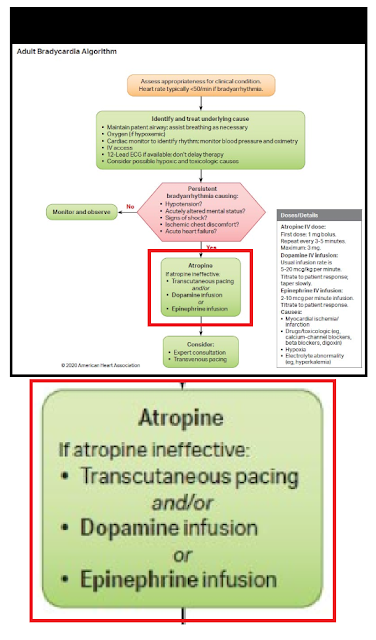
AHA ACLS 2020 bradycardia algorism
2023-11-13 成人心搏過緩流程圖 (AHA Algorism)
觀看AHA影片介紹(AHA影片需另外付費). 先打atropine之後就開始準備 TCP
接著視情況給予 epinephrine 或 dopamine 持續注射(需使用機械幫浦控制劑量)
不過流程圖看起來也可以解釋成
atropine 無效之後. TCP 或dopamine或epinephrine 的地位是相同的.
你也可以同時選擇 TCP + dopamine
atropine 無效之後. TCP 或dopamine或epinephrine 的地位是相同的.
你也可以同時選擇 TCP + dopamine
或 TCP + epinephrine.
或者只選 TCP
或者不使用 TCP 而是直接給藥(dopamine or epinephrine 選一種)
但不能同時使用 dopamine + epinephrine.
但不能同時使用 dopamine + epinephrine.
訂閱:
文章 (Atom)
-
縮寫及名詞解釋 AHA美國心臟學會 ASA美國腦中風學會 VF 心室顫動 VT 心室頻脈 AF 心房顫動 (建議不要以英文大小些區分顫動或撲動) AFL 心房撲動 MACE 主要不良心血管事件 MACE包含心因性死亡, 非致死的心肌梗塞, 非致死的中風 (CV death, no...
-
2026-01-22 15:27 相關筆記 hypoxia and hypoxemia 缺氧與低血壓的差異 以血氧飽和度預測是否發生AMS Pulse oximetry for the prediction of acute mountain sickness: A syste...
-
2026-08-11 0:24 第一類急救站傷患緊急後送標準 下列異常情況建議立即連繫後送醫院, 1.呼吸與循環異常:(無法在急救站簡易處置就改善) 呼吸>30 血氧飽和度<94% 呼吸困難、呼吸衰竭. 呼吸停止、嚴重胸痛(疑似心肌梗塞) 心跳<50 或 ...

